
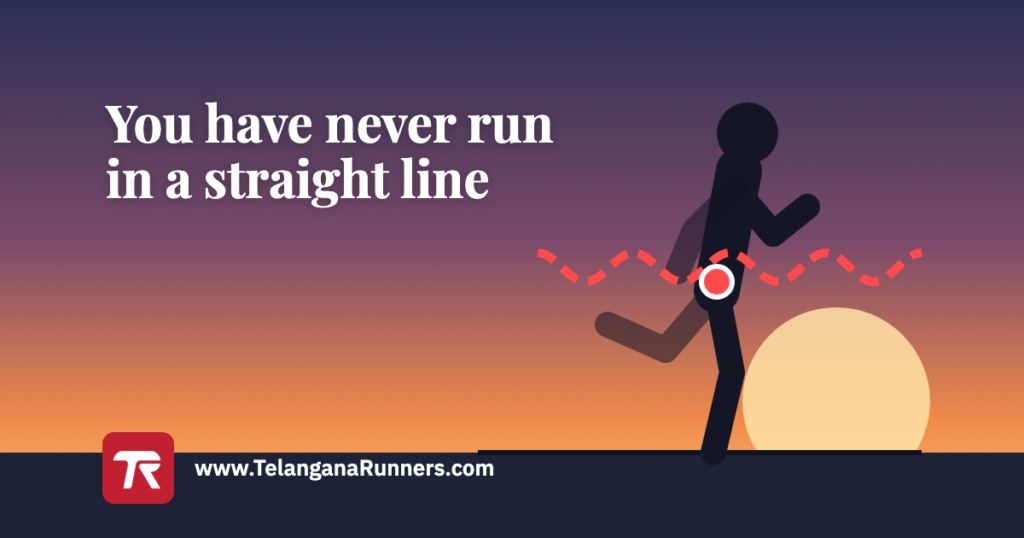
Short answer: You may run along a straight road, but your centre of gravity never does. It rises and falls with every stride and sways over each foot. When you walk, it swings like a pendulum and reuses about 65% of the energy each step. When you run, it bounces like a spring, with your tendons storing energy and giving it back (Cavagna, 1977).
The short version
- Your centre of gravity moves in a wave, never a straight line.
- Walking works like a pendulum: about 65% of the energy is reused.
- Running works like a spring: tendons and the foot arch store energy.
- Your natural sway, side to side, costs the least energy.
- Progress is never a straight line. Nature moves in waves.
Where is your centre of gravity?
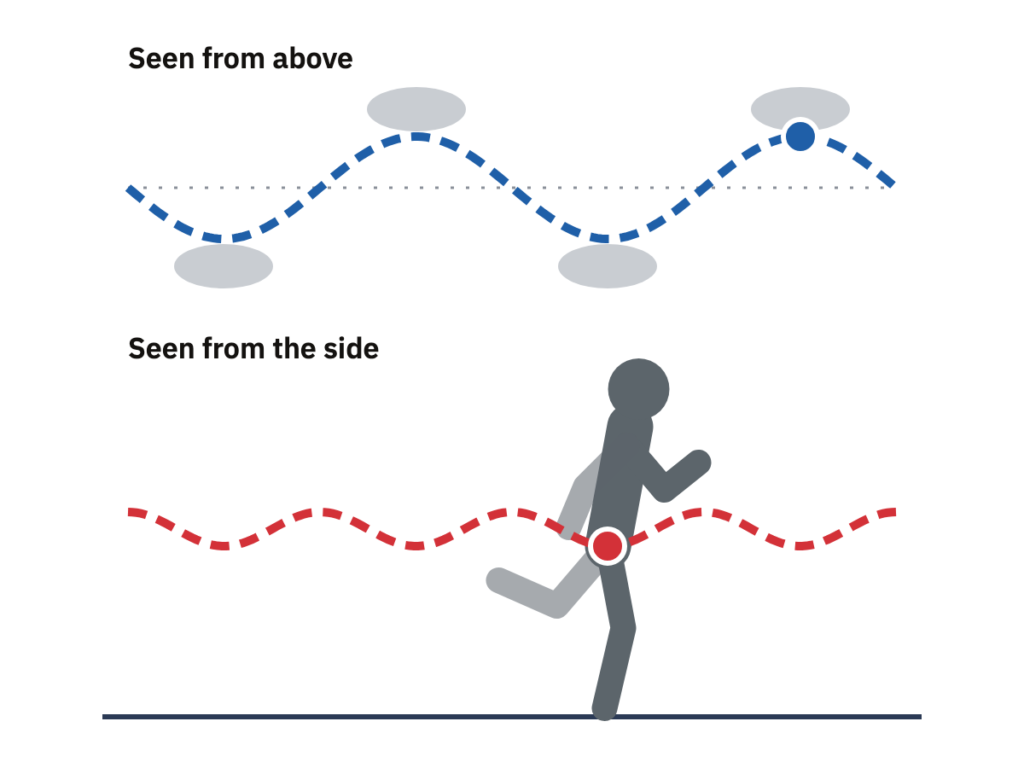
Your centre of gravity is the balance point of your whole body, a little below your belly button. When you walk or run, it carries all your weight forward. Most runners picture it gliding in a straight line. Science says otherwise (Saunders, Inman and Eberhart, 1953).
Walking: a pendulum
When you walk, your body rises over the foot on the ground and then comes down into the next step. Your stiff leg acts like an upside-down pendulum (Kuo and Donelan, 2010). Going up, speed turns into height. Coming down, height turns back into speed.
This swap reuses about 65% of the energy in each step (Cavagna, Heglund and Taylor, 1977). When people tried to walk with a flat centre, they used about twice the energy (Ortega and Farley, 2005). The wave is not wasted movement. It is how walking saves energy.
Running: a spring
Running flips the wave. Your centre is lowest when your foot is on the ground, and highest when you are in the air. Your leg works like a spring: it squashes on landing and pushes you back up (Cavagna, Heglund and Taylor, 1977).
The spring is real. When you land, your tendons and the arch of your foot stretch and store energy. They give it back as you push off (Ker and others, Nature, 1987). That is free energy in every stride. Building endurance trains this spring, run after run.
Side to side, too
You land on one foot at a time, so your centre shifts over each foot in turn. When people walked with wider steps than normal, the energy cost rose by up to 45% (Donelan, Kram and Kuo, 2001). The sway your body chooses on its own is the cheapest one. The medical side, for people walking again after a heart problem, is on the Cardiac Rehab blog.
Why does a wave beat a straight line?
Picture two steel balls racing down two tracks. Same start, same finish. One track is straight, the other dips like a wave. The ball on the wave wins: 0.95 seconds against 1.01 seconds in our physics model. Trading height for speed pays.
Your body uses that same trade every step you take. You think you move in a straight line. Your body knows better. Progress is never a straight line. Nature moves in waves.
Your questions, answered
Does my body move up and down when I run?
Yes. Your centre of gravity is lowest when your foot is on the ground and highest in the air. Your legs work like springs. Tendons and the foot arch store energy when you land. They give it back as you push off.
Why do we sway side to side when walking?
You stand on one foot at a time, so your weight shifts over each foot in turn. The sway your body chooses on its own costs the least energy. Walking with much wider steps than normal cost up to 45% more energy in one study.
Is the up and down movement wasted energy?
No. In walking it works like a pendulum. Going up stores energy as height, and coming down gives it back as speed. About 65% is reused. People who tried to walk with a flat centre used about twice the energy.
Should I try to run flatter?
No. Your body chooses its own wave and its own sway, and those cost the least. When people tried to walk with a flat centre, they used about twice the energy. With much wider steps than normal, the cost rose by up to 45%. Run relaxed, and let building endurance train the spring in your legs.
Start with the next run
You do not need to be fast, and you do not need to be young. Find the next Telangana Runners run in Hyderabad at www.TelanganaRunners.com. Come once, walk if you need to, and come back next week. Your body already knows the wave. We just give it a road. Want another reason to keep going? Read Your legs are your biggest sugar user.
References
- Saunders JB, Inman VT, Eberhart HD. The major determinants in normal and pathological gait. J Bone Joint Surg Am. 1953;35-A:543-558. semanticscholar.org/paper/The-major-determinants-in-normal-and-pathological-Saunders-Inman/1613ec5693a1e808d14ba0800b2ddd48063d03bf
- Kuo AD, Donelan JM. Dynamic principles of gait and their clinical implications. Phys Ther. 2010. pubmed.ncbi.nlm.nih.gov/20023002
- Cavagna GA, Heglund NC, Taylor CR. Mechanical work in terrestrial locomotion: two basic mechanisms for minimizing energy expenditure. Am J Physiol. 1977. doi.org/10.1152/ajpregu.1977.233.5.R243
- Ortega JD, Farley CT. Minimizing center of mass vertical movement increases metabolic cost in walking. J Appl Physiol. 2005. doi.org/10.1152/japplphysiol.00103.2005
- Donelan JM, Kram R, Kuo AD. Mechanical and metabolic determinants of the preferred step width in human walking. Proc R Soc Lond B. 2001. doi.org/10.1098/rspb.2001.1761
- Ker RF, Bennett MB, Bibby SR, Kester RC, Alexander RM. The spring in the arch of the human foot. Nature. 1987. doi.org/10.1038/325147a0