

Short answer: Your legs are the biggest sugar user you own. Muscles take up about 80% of the sugar cleared under insulin, and running opens a second door into them. That door still works in diabetes. Regular structured exercise lowered HbA1c by 0.67% (Umpierre, JAMA, 2011). Here is how running and blood sugar are linked.
The short version
- Diabetes care is moving beyond sugar alone, says BW Healthcare World.
- About 80% of the sugar taken up under insulin goes into your muscles.
- Running opens a sugar door in the muscle that still works when insulin is weak.
- Training builds more doors, by flipping switches on a gene: epigenetics.
- Exercise works with diabetes medicines, never instead of them.
What did the news say?
On 28 September 2026, BW Healthcare World wrote that diabetes care now looks at the whole person. Weight, heart, kidneys and lifestyle all count, not only sugar. It also listed new medicines, from drugs that act on three hormones to cell therapy.
New medicines are welcome. But there is one sugar user every runner already carries, and it costs nothing. It is the big muscles in your legs.
Where does your blood sugar go?
After you eat, sugar goes into your blood, and insulin helps the body take it in. Most of it goes into your muscles. About 80% of the sugar taken up under insulin ends up in skeletal muscle (DeFronzo and Tripathy, Diabetes Care, 2009).
Your thighs, calves and hips are the largest muscles you have. When they sit still all day, that huge sugar store sits idle. When they run, they go looking for fuel.
How does running pull sugar out of the blood?
Sugar gets into muscle through doors called GLUT4. Insulin opens them, but in type 2 diabetes insulin works poorly. Moving muscles have their own way to open the doors. In people with type 2 diabetes, one exercise session still opened them (Kennedy, Diabetes, 1999).
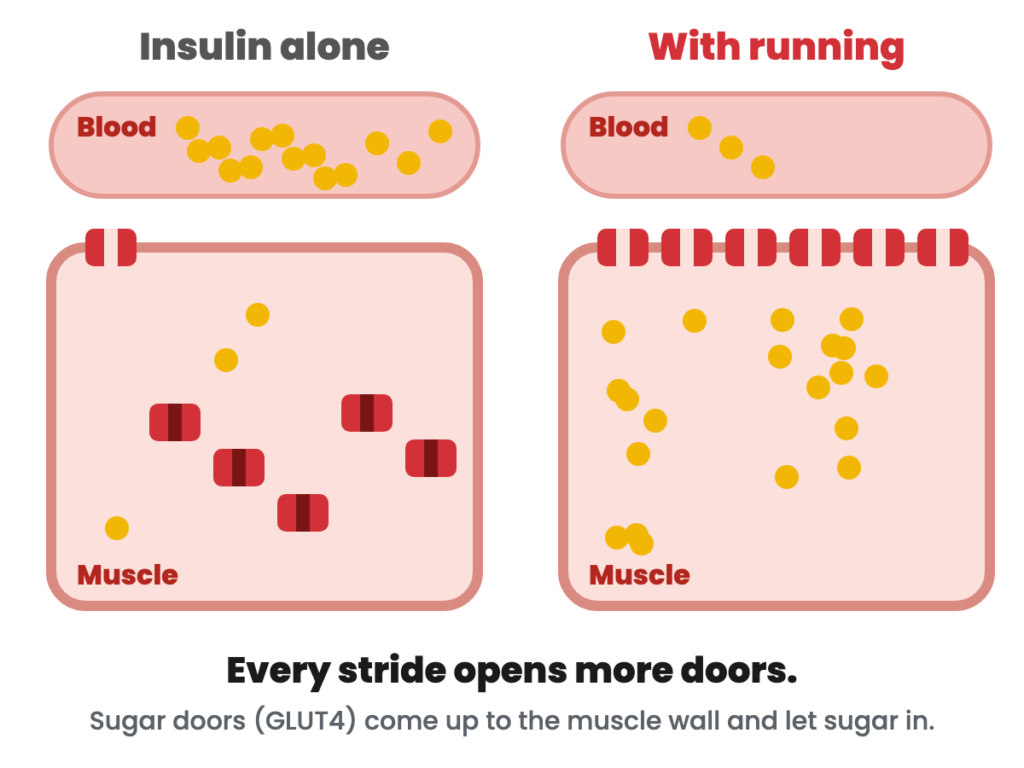
More running, more doors
Regular training makes the muscle build more of these doors. Exercise training is the strongest known way to do it (Richter and Hargreaves, Physiol Rev, 2013). Part of how it works is epigenetics: training flips switches on the gene that makes the doors. The fitter your legs, the more sugar they can take in.
Does it show in the blood test?
Yes. In people with type 2 diabetes, structured exercise lowered HbA1c by 0.67% (Umpierre, JAMA, 2011). More than 150 minutes a week lowered it by 0.89%. That is about 30 minutes, five days a week.
Just being told to be active did not work on its own. What worked was a plan followed week after week. For runners, that plan is simple: show up, move, and come back next week.
Always with your medicines. Running changes how your sugar behaves. Talk to your doctor before you change any tablet or insulin dose.
How do I start if I have diabetes?
Get a heart check first. Diabetes can hide heart trouble, because it can dull the warning pain. If you have a heart condition, start with physician supervised exercise at our sister clinic, Cardiac Rehab. Then bring your legs to the road.
Start with walks, then walk and jog. Carry something sweet on your first runs, and check your sugar before and after. Over weeks your legs will get better at their job. Every kilometre, they pull sugar out of your blood. The clinic explains the same science for patients in its twin post: Diabetes and your muscles.
Your questions, answered
Does running lower blood sugar?
Yes. Running muscles pull sugar out of the blood through their own doors. In type 2 diabetes, structured exercise lowered HbA1c by 0.67%, and by 0.89% with more than 150 minutes a week. What matters is a plan followed week after week; being told to be active did not lower HbA1c on its own.
Why are my legs the biggest sugar user?
Muscle takes up about 80% of the sugar cleared under insulin, and your legs hold your largest muscles. When they work, they draw sugar from the blood for fuel. Your thighs, calves and hips are the largest muscles you have. When they sit still all day, that sugar store sits idle.
Can I run if I have diabetes?
Most people can, after a heart check. Start slowly, check your sugar before and after, and carry a sweet in case it drops. If you have a heart condition, start with supervised exercise first. Start with walks, then walk and jog, and come back every week.
Can running replace my diabetes medicines?
No. Running works alongside medicines. If your sugar improves, your doctor may change a dose, but never change it on your own. Exercise changes how your sugar behaves, so your tablets or insulin may need adjusting. Talk to your doctor before you change anything, and keep checking your sugar.
Start with the next run
You do not need to be fast, and you do not need to be young. Find the next Telangana Runners run in Hyderabad at www.TelanganaRunners.com. Come once, walk if you need to, and come back next week. Every week you are building endurance, and your legs get better at pulling sugar out of your blood. Heart disease in your family? Read Heart disease runs in my family. Can running change that?
References
- BW Healthcare World. Diabetes care moves beyond blood sugar control. 28 September 2026. bwhealthcareworld.com/article/diabetes-care-moves-beyond-blood-sugar-control-625815
- DeFronzo RA, Tripathy D. Skeletal muscle insulin resistance is the primary defect in type 2 diabetes. Diabetes Care. 2009. doi.org/10.2337/dc09-S302
- Kennedy JW, et al. Acute exercise induces GLUT4 translocation in skeletal muscle of normal human subjects and subjects with type 2 diabetes. Diabetes. 1999. doi.org/10.2337/diabetes.48.5.1192
- Richter EA, Hargreaves M. Exercise, GLUT4, and skeletal muscle glucose uptake. Physiol Rev. 2013. doi.org/10.1152/physrev.00038.2012
- Umpierre D, et al. Physical activity advice only or structured exercise training and association with HbA1c levels in type 2 diabetes. JAMA. 2011. pubmed.ncbi.nlm.nih.gov/21540423