

Short answer: The block that causes a heart attack can grow in the arteries of your legs too. Blocked leg arteries show up as calf pain when you walk that goes away when you stop. The causes are the same as a heart attack, and the answer is the same too: building endurance, step by step.
The short version
- Blocked leg arteries are the same disease as heart attacks, in the legs.
- The sign: calf pain on walking that eases when you stop.
- Diabetes, smoking, BP, cholesterol and family history raise the risk.
- Building endurance softens your arteries and can widen them.
- After a procedure, keep building endurance.
Can your legs have a heart attack?
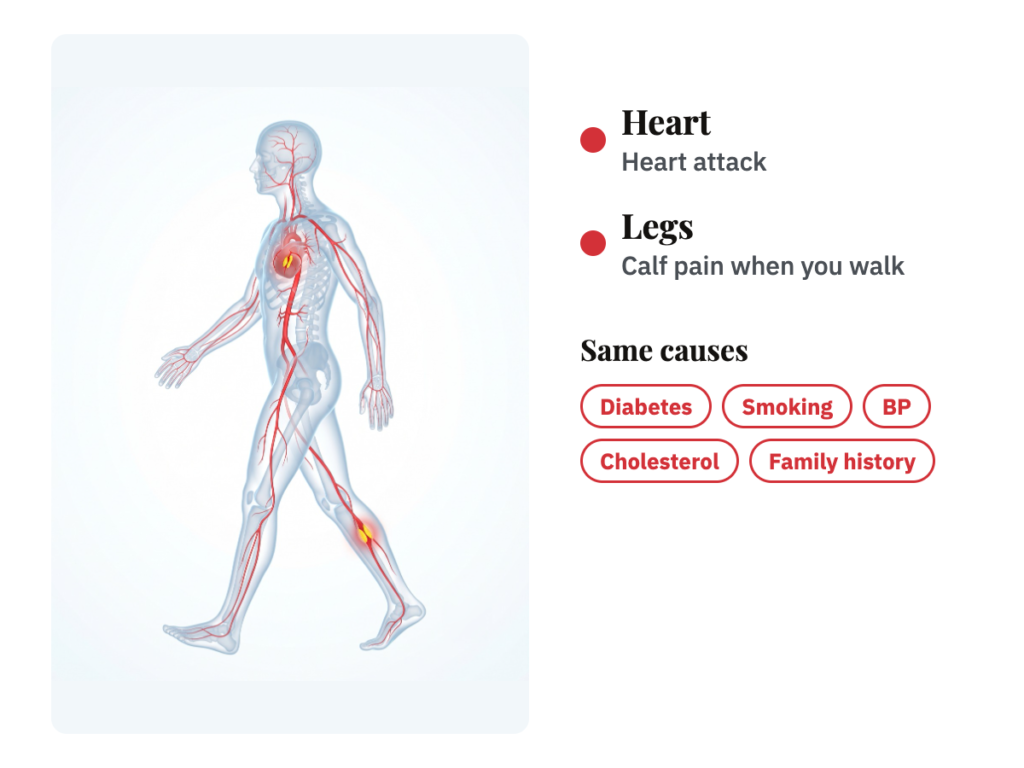
Not exactly, but close. A heart attack happens when fatty plaque blocks a heart artery. The same plaque can block the arteries that feed your legs. Doctors call all of this peripheral vascular disease, or PVD. About 202 million people had it in 2010, 54.8 million of them in southeast Asia (Fowkes, Lancet, 2013).
What does it feel like?
The best known sign is calf pain when you walk. It makes you stop. It eases after a short rest, and it comes back at the same distance. Other signs are a cold foot and cuts on the feet that do not heal. The skin on the legs may turn shiny and dry, with less hair (Hindustan Times, 2026).
Many people blame this on age or their knees, says vascular surgeon Dr Rajiv Parakh. If your calves hurt every time you walk the same distance, get your legs checked. A simple test compares the blood pressure in your arms and ankles.
Who gets blocked leg arteries?
The risk list is almost the same as for heart attacks. Smoking, diabetes, high blood pressure and high cholesterol all raised the risk in a large study (Fowkes, Lancet, 2013). A family history adds to it. If you have one of these, your legs and your heart both need looking after.
Why is building endurance the answer?
Walking does not dissolve the block. It changes the pipe around it and the muscle it feeds. Endurance training makes stiff arteries softer (Bakali, Open Heart, 2023). In people with leg artery disease, supervised training widened a deep thigh artery. The wider it got, the further they walked (Dopheide, Eur J Prev Cardiol, 2017).
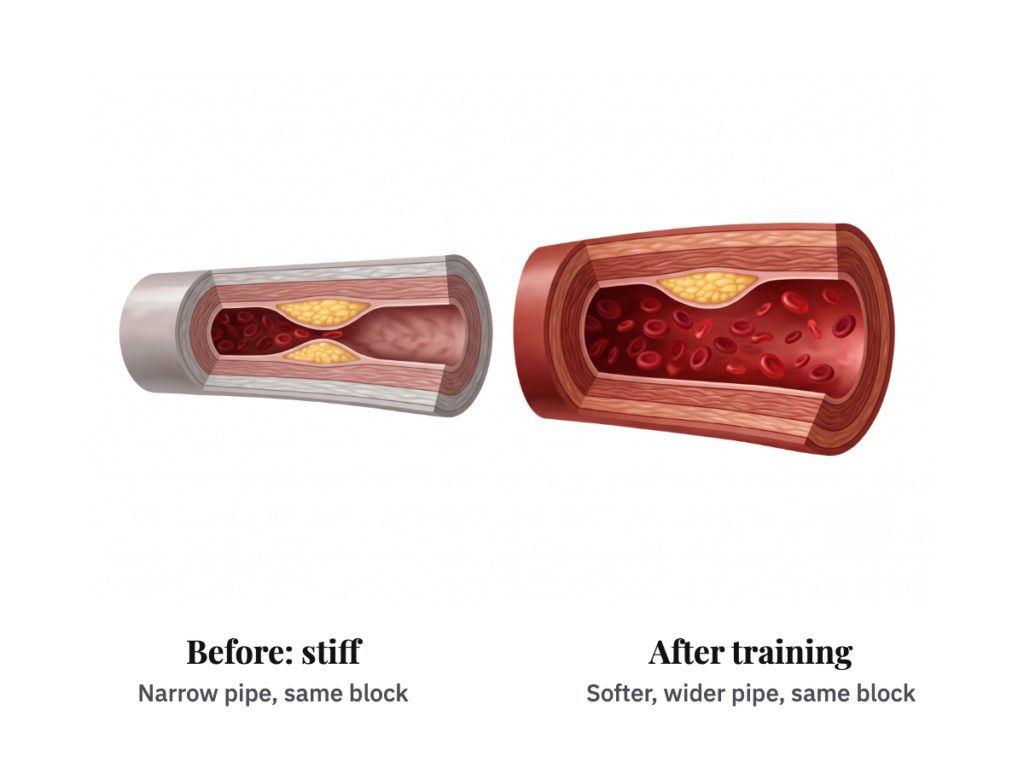
The muscle changes too. Training builds more of its power stations, so the calf makes more energy from the same blood. The artery lining relaxes better, and inflammation goes down (Hamburg and Balady, Circulation, 2011).
The results are real. In a review of 32 trials, exercise added about 120 metres of total walking, and the gains lasted up to two years (Lane, Cochrane, 2017). The 2024 American guideline says structured exercise should be offered as a first treatment for leg pain on walking. Building endurance, week after week, is exactly that.
Already had a stent in your leg?
A stent opens the pipe, but the legs still need training. In one trial, people who trained after their stent walked about 1,237 metres further after a year (Fakhry, JAMA, 2015). The guideline gives exercise after a leg procedure its top grade.
Exercise also brings down the causes of the block. In blocked heart arteries, a year of exercise and a low-fat diet helped. Blocks grew in 23% of people, against 48% on usual care (Schuler, Circulation, 1992). Start with a heart and leg check, then walk with us. The medical side of this, for people already in treatment, is on the Cardiac Rehab blog.
Your questions, answered
Can young people get blocked leg arteries?
It is more common as people get older, but the causes start early. Smoking, diabetes and high cholesterol at a young age all add up. Building endurance now, and not smoking, protect both your heart and your legs. If your calves hurt every time you walk the same distance, see a doctor.
Should I keep walking if my calves hurt?
If you have pain on walking, get checked first. Once a doctor clears you, walking to mild or moderate pain, resting, and walking again is how the training works. Do not push through severe pain, and do not stop altogether. Your walks will slowly get longer.
Does running help after a leg stent?
Training after a leg procedure helps people walk further, and the 2024 guideline rates it highly. Start with walking under medical advice, then build up. Exercise also helps bring down blood sugar, one of the same causes that made the block.
Are blocked leg arteries the same as a heart attack?
They are the same kind of block in a different place. Fatty plaque narrows the artery. In the heart it can cause a heart attack, and in the legs it causes calf pain on walking. The causes are the same too: smoking, diabetes, high BP, high cholesterol and family history.
Building endurance: your way to stay free from PVD
Get your legs checked. Then walk with us. You do not need to be fast, and you do not need to be young. Find the next Telangana Runners run in Hyderabad at www.TelanganaRunners.com. Walk if you need to, and come back next week. Every week you are building endurance, in your heart and in your legs. Curious about the wave in every stride? Read You have never run in a straight line.
References
- Dogra T. Peripheral vascular disease (PVD): Vascular surgeon Dr Rajiv Parakh explains the symptoms, risks, prevention, treatment. Hindustan Times, 1 October 2026. hindustantimes.com/lifestyle/health/peripheral-vascular-disease-pvd-vascular-surgeon-dr-rajiv-parakh-explains-the-symptoms-risks-prevention-treatment-101790261231853.html
- Fowkes FG, et al. Comparison of global estimates of prevalence and risk factors for peripheral artery disease in 2000 and 2010. Lancet. 2013;382:1329-40. pubmed.ncbi.nlm.nih.gov/23915883
- Bakali M, et al. Effect of aerobic exercise training on pulse wave velocity in adults with and without long-term conditions: a systematic review and meta-analysis. Open Heart. 2023;10:e002384. pubmed.ncbi.nlm.nih.gov/38101857
- Dopheide JF, et al. Supervised exercise training in peripheral arterial disease increases vascular shear stress and profunda femoral artery diameter. Eur J Prev Cardiol. 2017;24:178-191. pubmed.ncbi.nlm.nih.gov/27550906
- Hamburg NM, Balady GJ. Exercise rehabilitation in peripheral artery disease: functional impact and mechanisms of benefits. Circulation. 2011;123:87-97. pubmed.ncbi.nlm.nih.gov/21200015
- Schuler G, Hambrecht R, et al. Regular physical exercise and low-fat diet. Effects on progression of coronary artery disease. Circulation. 1992;86:1-11. pubmed.ncbi.nlm.nih.gov/1617762
- Lane R, Harwood A, Watson L, Leng GC. Exercise for intermittent claudication. Cochrane Database Syst Rev. 2017;12:CD000990. pubmed.ncbi.nlm.nih.gov/29278423
- Gornik HL, et al. 2024 ACC/AHA Guideline for the Management of Lower Extremity Peripheral Artery Disease. J Am Coll Cardiol. 2024;83:2497-2604. pubmed.ncbi.nlm.nih.gov/38752899
- Fakhry F, et al. Endovascular revascularization and supervised exercise for peripheral artery disease and intermittent claudication (ERASE). JAMA. 2015. pubmed.ncbi.nlm.nih.gov/26547465