


Short answer: To reduce HbA1c, look at both sides of the sugar equation. Sugar goes into your blood from food every day, and you cannot stop that. The way out is your muscles. When they work, they pull sugar out of your blood, even without insulin, for up to two full days. Across 47 trials, planned exercise lowered HbA1c by 0.67 points.
The short version
- For every 1 point lower HbA1c, people had 14% fewer heart attacks (UKPDS 35).
- Sugar comes in from food every day. High sugar is also about sugar not going out.
- Your muscles are the biggest sugar users in your body.
- One workout keeps them pulling sugar out for up to two full days.
- Planned exercise lowered HbA1c by 0.67 points across 47 trials.
Why does your HbA1c matter?
Your HbA1c is the number that tells you how much sugar has been sitting in your blood. It is not just a number on a report. In the UKPDS 35 study, for every 1 point lower HbA1c, people had 14% fewer heart attacks (Stratton, BMJ, 2000). So every point you bring down counts.
Most people are told one thing about it: eat less sugar. That advice is not wrong. But it looks at only one side of the problem. There is a second side, and it is the side you can train.
Is high sugar only about what you eat?
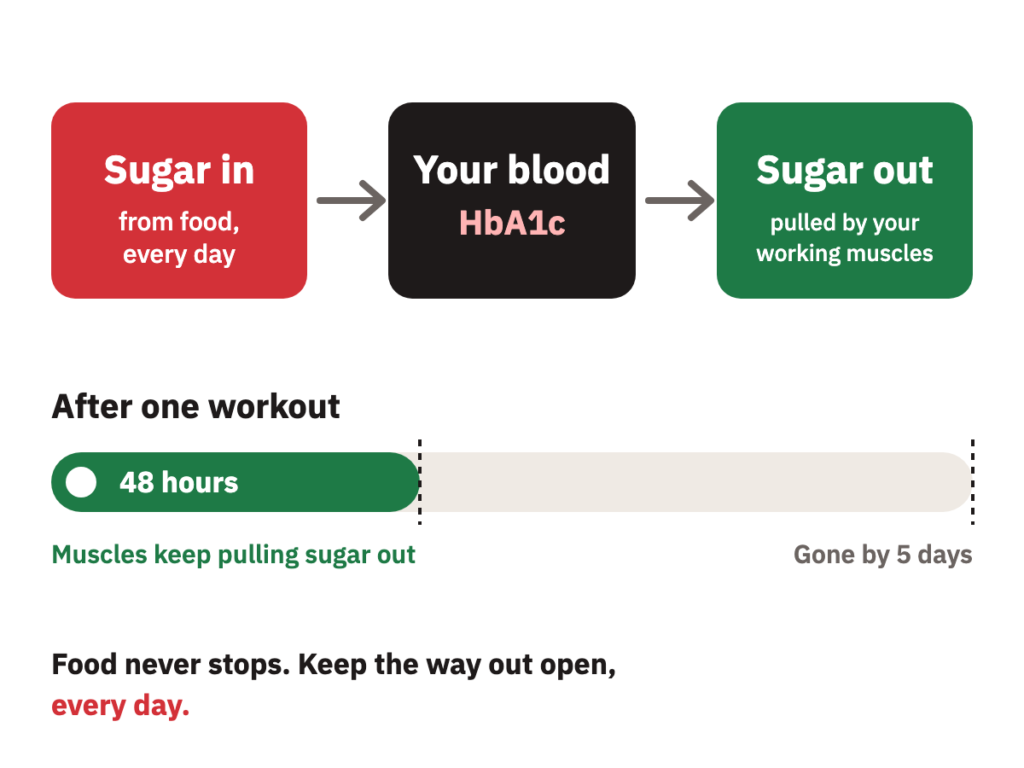
Think of your blood sugar as an equation. On the left side, sugar goes into your blood every day, from food. You cannot stop that, because you have to eat. On the right side, sugar goes out of your blood, into the parts of your body that use it.
High blood sugar is not only about sugar going in. It is about sugar not going out. If the way out is slow, even a careful plate leaves sugar sitting in your blood. So the better question is not only what you ate today. It is how much sugar your muscles used today.
How do your muscles help reduce HbA1c?
Your muscles are the biggest sugar users in your body. When insulin works, about 80% of the sugar taken from the blood goes into muscle (DeFronzo and Tripathy, Diabetes Care, 2009). No other part of you takes in so much. That makes your muscles the main way out.
When a muscle works, it pulls sugar in by itself. A working muscle can take sugar out of the blood even without insulin (Santos, Int J Sports Med, 2008). This matters, because in type 2 diabetes insulin works poorly. The working muscle uses its own route, and that route still works.
One workout lasts two full days
After one session, insulin works better for about 48 hours (Mikines, Am J Physiol, 1988). So your muscles keep draining sugar for up to two full days. By five days, that effect is gone. So one good day cannot fix your HbA1c. But a good day every day or two keeps the way out open.
Does exercise really lower HbA1c?
Yes, and it has been measured many times. Across 47 trials, planned exercise lowered HbA1c by 0.67 points (Umpierre, JAMA, 2011). With more than 150 minutes a week, it fell by 0.89 points. That is close to a full point, and a full point meant 14% fewer heart attacks in UKPDS 35.
The same holds for people who already have heart disease. In heart patients with diabetes, exercise based cardiac rehab lowered HbA1c by 0.47 points across 18 trials (Zhang, BMC Cardiovasc Disord, 2026). If you have a heart condition, ask your doctor first. Read more on the Cardiac Rehab blog. Your muscles work the same way, but your plan should be safe first.
What should you ask yourself today?
Tablets help, so keep taking them as your doctor says. But ask yourself one more question every evening: how much sugar did my muscles eat today? Be the master of your sugar. Build your endurance, and let your muscles do the work every day.
Your questions, answered
Can exercise reduce HbA1c?
Yes. Across 47 trials, planned exercise lowered HbA1c by 0.67 points. People who did more than 150 minutes a week saw it fall by 0.89 points. Working muscles pull sugar out of your blood, even when insulin works poorly. The key is a plan you follow week after week, not one hard day.
How long does one workout keep working on my sugar?
After one session, insulin works better for about 48 hours. That means your muscles keep pulling sugar out of your blood for up to two full days. By five days, the effect is gone. So it helps to move every day, or at least every other day, rather than once a week.
Why do muscles matter so much for blood sugar?
Your muscles are the biggest sugar users in your body. When insulin works, about 80% of the sugar taken out of the blood goes into muscle. A working muscle can also pull sugar in without insulin. More muscle that works often means a wider way out for sugar.
Can I stop my diabetes tablets if I start running?
No, not on your own. Tablets help, and exercise works alongside them. As your sugar improves, your doctor may change a dose, but only your doctor should decide that. Tell your doctor before you start, and check your sugar more often in the first few weeks.
Build Your Endurance Now
You do not need to be fast to start. Come to a Telangana Runners run in Hyderabad, walk if you need to, and come back next week. Every week of building endurance makes your muscles better at pulling sugar out of your blood. Find the next run at www.TelanganaRunners.com. Want the science of how muscles take in sugar? Read How running lowers blood sugar.
References
- Stratton IM, et al. Association of glycaemia with macrovascular and microvascular complications of type 2 diabetes (UKPDS 35). BMJ. 2000. doi.org/10.1136/bmj.321.7258.405
- DeFronzo RA, Tripathy D. Skeletal muscle insulin resistance is the primary defect in type 2 diabetes. Diabetes Care. 2009. doi.org/10.2337/dc09-S302
- Santos JM, et al. Skeletal muscle pathways of contraction-enhanced glucose uptake. Int J Sports Med. 2008. doi.org/10.1055/s-2008-1038404
- Mikines KJ, et al. Effect of physical exercise on sensitivity and responsiveness to insulin in humans. Am J Physiol. 1988. doi.org/10.1152/ajpendo.1988.254.3.E248
- Umpierre D, et al. Physical activity advice only or structured exercise training and association with HbA1c levels in type 2 diabetes. JAMA. 2011. doi.org/10.1001/jama.2011.576
- Zhang M, et al. Effects of exercise-based cardiac rehabilitation for coronary heart disease combined with diabetes mellitus: a systematic review and meta-analysis. BMC Cardiovasc Disord. 2026. doi.org/10.1186/s12872-026-05606-1