


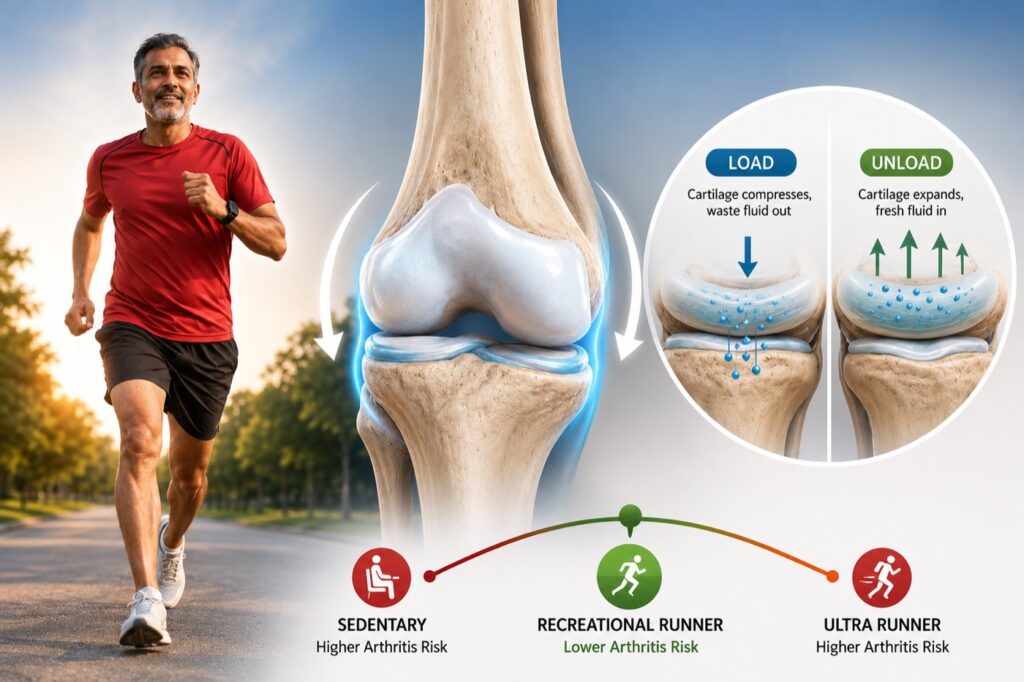
“Running will damage your knees.” You have heard this from a relative, a colleague, maybe even a doctor, and the uncomfortable part is that it is published in research. But recreational runners actually show a three fold lower prevalence of knee and hip arthritis compared to people who stay sedentary. Here is why the fear and the evidence point in opposite directions.
Where the fear actually comes from
Read the fine print on those studies. They looked at elite and ultra runners, people running five to six hours a day for twenty to thirty years of a professional career. That is the population carrying higher arthritis risk.
Somewhere along the way, that got shortened to four words: running causes arthritis. That is a hybrid statement, manufactured by people looking for an excuse not to start running.
You are not an elite athlete. You are a recreational runner. You do not run five hours a day for three decades. The evidence for people like you says the exact opposite of what you have been told.
How cartilage actually feeds itself
Every organ in your body has its own blood supply, one vessel bringing nutrition, another removing waste. Cartilage has no blood supply at all. So how does it eat?
Cartilage behaves like a sponge. Load the knee joint, and cartilage compresses, squeezing waste fluid out into the joint space. Unload it, and cartilage expands, drawing in fresh, nutrient rich synovial fluid.
Load. Unload. Load. Unload. That rhythm is literally how your cartilage feeds itself.
Every step you take is a meal for your knee. Which means the recreational runner walking or running regularly is building thicker, healthier cartilage than the person sitting still to protect their knees.
Where you actually want to sit on the risk curve
The sedentary person and the ultra marathoner sit at opposite ends of the same risk curve. You want to live in the middle. Your knees were not designed to be protected in stillness, they were designed to be used.
Recreational running is good for your knee joint. Start building your endurance.
Common questions
Does this apply if I already have some knee pain?
Existing joint pain needs individual assessment before starting or increasing a running routine, this article describes the general population evidence, not a substitute for a personal evaluation.
How much running counts as recreational versus high risk?
The elevated arthritis risk in the research applies to elite and ultra endurance volumes, several hours daily for decades. A structured, moderate weekly routine, like the pace built in our Sunday Morning Run, sits well within the protective range the evidence describes.
Should I still get my knees checked before starting?
If you are new to running, managing weight, or returning after a long break, a structured, graded start matters more than the running itself. Our FAQ page covers how to begin safely.
This guidance reflects the same principle I use with patients rebuilding endurance after a cardiac event, movement is not the risk, the absence of it is. If fear of joint damage is the only thing keeping you from starting, that fear is not supported by the evidence.
Dr Muralidar Babi, MBBS, MD (CMC Vellore)
Cardiac Rehab Physician, Founder, Telangana Runners
TGMCI Reg. No. 59309