



Short answer: Running and gut bacteria go together. About 55% of the dry part of your poop is bacteria, and they turn fibre into fuel your body uses. In a 6-week study, endurance exercise 3 days a week raised the bacteria that make that fuel. Stop, and the gain faded. So keep running.
The short version
- Endurance exercise 3 days a week for 6 weeks raised fuel-making gut bacteria in lean adults.
- When exercise stopped for 6 weeks, most of the change went away.
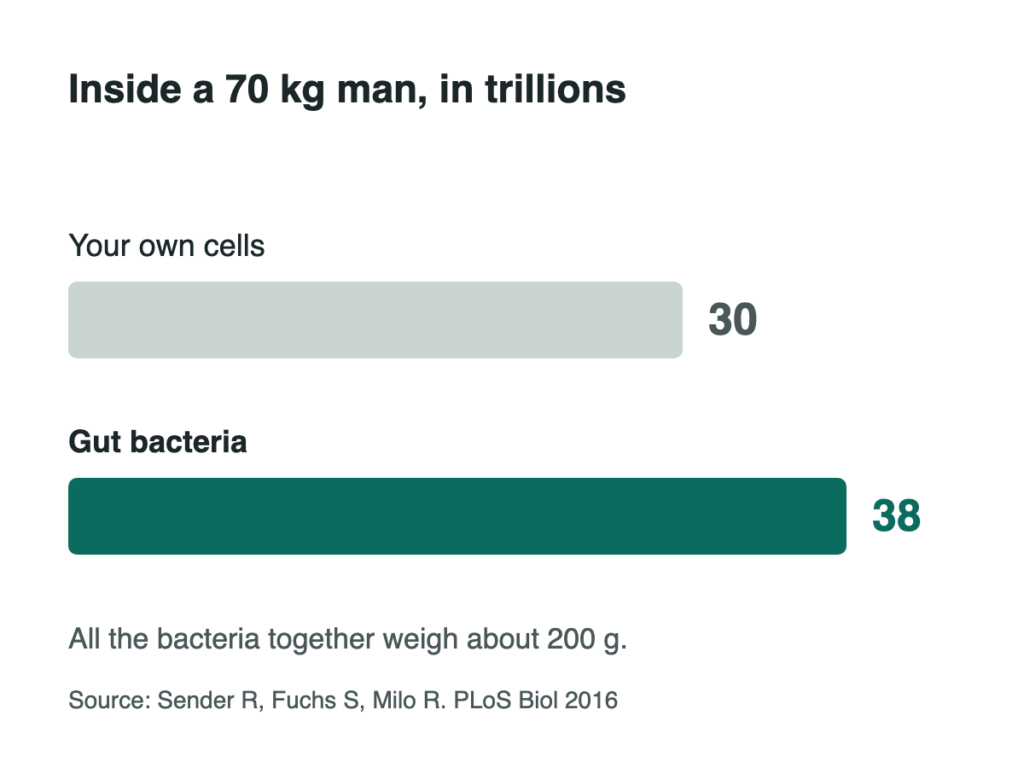
- You carry about 38 trillion gut bacteria, about 200 g in all.
- One antibiotic course changed the gut within 3 to 4 days.
- Packet-food preservatives slowed gut bacteria in the lab and changed them in mice.
Running and gut bacteria: what the study found
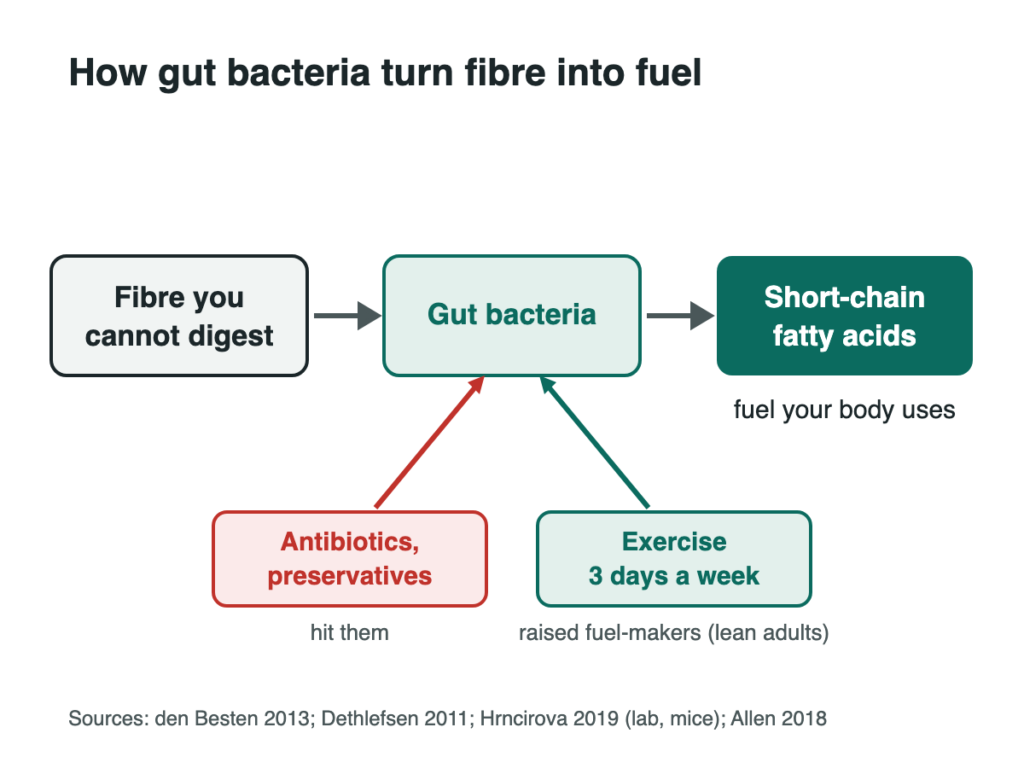
In a 6-week study of 32 adults who had not been exercising, everyone did supervised endurance training 3 days a week, building from 30 to 60 minutes. In lean adults, the bacteria and genes that make short-chain fatty acids went up, and so did the acids themselves. The rise was not seen in adults with obesity.
Then they stopped for 6 weeks, and the changes mostly went away. So the gain lasts only as long as the habit does. Steady running, week after week, is what keeps it. Building endurance slowly is how runners make that habit last.
How many bacteria live in you?
Take the water out of stool and weigh what is left. In a careful study of nine healthy adults, about 55% of that dry part was bacteria. Not leftover food: bacteria.
A 2016 recount put the number at about 38 trillion bacteria in a 70 kg man, about 1.3 for every one of his own cells. Most live in the large gut. All together they weigh about 200 g. The paper says older figures of 1 to 3 kg of bacteria should be replaced.
Many of them are alive when they leave. When stool bacteria were sorted one by one, 49% were intact, 19% were injured and 32% were dead. So the bacteria you pass each day are a living part of you, not just waste.
They work for you
Your gut bacteria eat the fibre your own body cannot digest. They turn it into short-chain fatty acids, which your body takes in and uses for energy. That is why fibre from dal, vegetables and whole grains feeds them, and why they are worth looking after.
Antibiotics hit them hard
Antibiotics kill bacteria, and they do not pick only the bad ones. A Stanford team followed three people for ten months through two courses of the antibiotic ciprofloxacin. The gut bacteria lost variety and changed within 3 to 4 days of starting. They began to return about a week after each course, but the return was often incomplete, and the mix settled in a new state.
When you need an antibiotic, take it as your doctor prescribes and finish the course. Do not ask for one for every cold. If you are not sure whether you need one, ask your doctor.
Packet food and preservatives
Preservatives are added to packet food to stop germs from growing. Three common ones are sodium benzoate (E211), sodium nitrite (E250) and potassium sorbate (E202). In a lab test, they slowed the growth of bacteria taken from the human gut, and some of the friendly ones were the most sensitive.
In a second study, mice carrying human gut bacteria drank these three preservatives from birth, at the most that people in Europe are thought to eat in a day. Their gut bacteria shifted in an unhealthy direction. This result came from mice, not from people.
One honest note: these are lab and mouse results. No study in people has yet shown the same. Still, if packet food is a daily habit, your gut bacteria may be getting a small dose of germ killer every day. Read the label, and keep fresh, home-cooked food as the base.
A runner’s plan for the gut
Run on most days, easy and steady. Eat fibre at every meal: dal, vegetables, fruit, whole grains. Keep packet snacks for the odd day, not every run. Take antibiotics only when your doctor prescribes them. The heart side of this story is on the Cardiac Rehab blog: gut bacteria and how to keep them strong.
Your questions, answered
Does running change gut bacteria?
In one study, 6 weeks of endurance exercise 3 days a week raised the bacteria that make short-chain fatty acids in lean adults, and raised the acids too (Allen 2018). The study was small, 32 adults, and the change was not seen in adults with obesity.
What happens to gut bacteria if I stop running?
In the same study, after 6 weeks without exercise most of the changes went away (Allen 2018). The benefit seems to last only as long as the habit does, which is one more reason to keep running steadily.
How many bacteria are in my gut?
About 38 trillion, weighing about 200 g in all (Sender 2016). That is a little more than the number of your own cells. In the dry part of stool, about 55% is bacteria (Stephen 1980). Many are still alive when they leave.
Are packet foods bad for gut bacteria?
Three common preservatives slowed gut bacteria in a lab test (Hrncirova 2019) and shifted them in mice (Hrncirova 2019). There is no proof yet in people, so keep packet food as the exception, not the daily habit.
Build Your Endurance Now
Steady running, week after week, is what kept the gut change going. Start easy and keep it regular. Read the heart side on Cardiac Rehab: gut bacteria.
References
- Allen JM, et al. Exercise alters gut microbiota composition and function in lean and obese humans. Med Sci Sports Exerc. 2018. pubmed.ncbi.nlm.nih.gov/29166320
- Sender R, Fuchs S, Milo R. Revised estimates for the number of human and bacteria cells in the body. PLoS Biol. 2016. pubmed.ncbi.nlm.nih.gov/27541692
- Stephen AM, Cummings JH. The microbial contribution to human faecal mass. J Med Microbiol. 1980. pubmed.ncbi.nlm.nih.gov/7359576
- Ben-Amor K, et al. Genetic diversity of viable, injured, and dead fecal bacteria assessed by fluorescence-activated cell sorting and 16S rRNA gene analysis. Appl Environ Microbiol. 2005. pubmed.ncbi.nlm.nih.gov/16085863
- den Besten G, et al. The role of short-chain fatty acids in the interplay between diet, gut microbiota, and host energy metabolism. J Lipid Res. 2013. pubmed.ncbi.nlm.nih.gov/23821742
- Dethlefsen L, Relman DA. Incomplete recovery and individualized responses of the human distal gut microbiota to repeated antibiotic perturbation. PNAS. 2011. pubmed.ncbi.nlm.nih.gov/20847294
- Hrncirova L, et al. Human gut microbes are susceptible to antimicrobial food additives in vitro. Folia Microbiol. 2019. pubmed.ncbi.nlm.nih.gov/30656592
- Hrncirova L, et al. Food preservatives induce Proteobacteria dysbiosis in human-microbiota associated Nod2-deficient mice. Microorganisms. 2019. pubmed.ncbi.nlm.nih.gov/31548508