



Short answer: Muscle glycogen and water go together. Muscles look fuller within a few weeks of training, and it is not all protein. Muscle stores sugar as glycogen, and each gram of glycogen holds at least three grams of water. The reason is one property of sugar: it is hygroscopic, a water magnet. Stop training and the stored sugar drops, and the water leaves with it. Running fills the tank again.
The short version
- Each gram of glycogen in muscle holds at least three grams of water.
- In the first weeks of training, part of the size gain is fluid, not new protein.
- Glucose is hygroscopic: it pulls water to itself.
- Stop using a muscle and its stored sugar falls. In one study, 40% in five weeks of a cast.
- During aerobic exercise, muscle takes in up to five times more sugar, for up to 48 hours after.
Muscle glycogen and water: one gram holds three grams
Muscle stores sugar in a packed form called glycogen. Glycogen never sits dry. In a study of runners recovering from a long run, each gram of glycogen the muscle rebuilt came with at least three grams of water. An older review put the figure at three to four parts water for each part glycogen. Muscle as a whole is about three-quarters water and one-fifth protein.
Why gym muscles look fuller within weeks
Lift weights for three weeks and the muscle already measures bigger. In one study, the early gain in muscle size came with swelling and fluid, before much new protein had been laid down. By ten weeks the muscle was about 10% bigger, and by then real protein growth had caught up. In another study, six weeks of high-volume training grew the fibres mostly through the fluid part of the cell, not the contracting proteins.
So the early fullness is partly water, and stored sugar holds a lot of that water. Muscle glycogen and water rise together as training goes on. The protein comes too, but it comes later and slower.
Why the water? Sugar is a water magnet
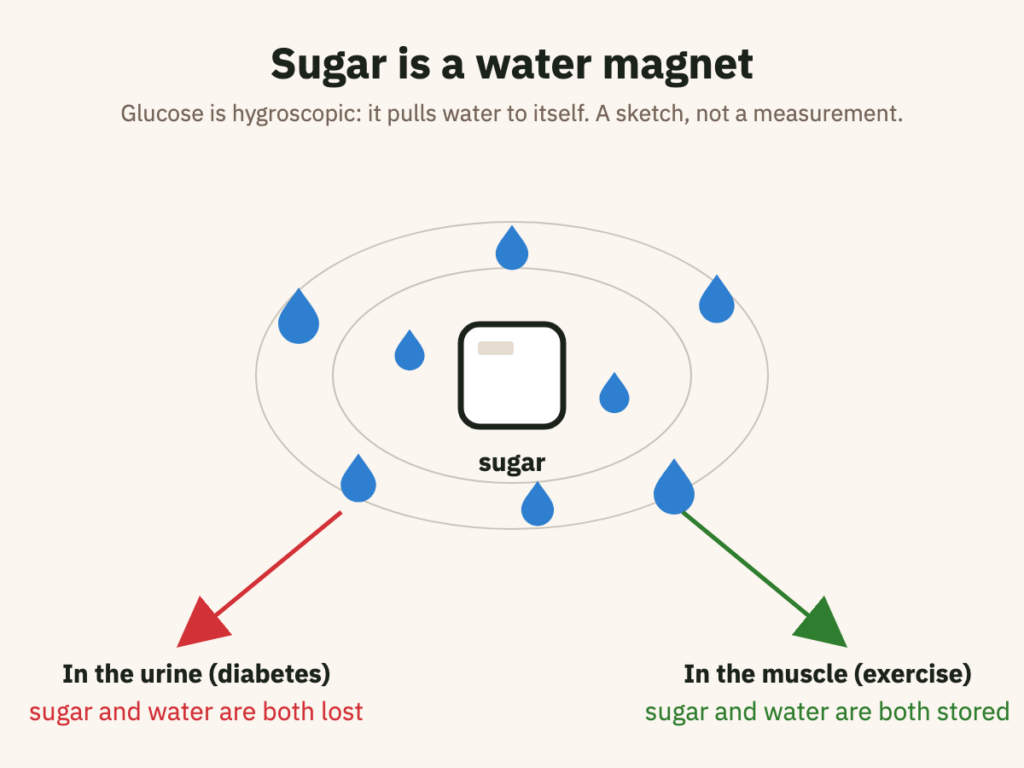
Glucose is hygroscopic. The word means it attracts water from around it and holds on. Sugar left open on a humid day goes damp for the same reason. Wherever sugar is stored, water is stored with it.
Stop, and the water leaves
The store runs both ways. In a classic study, five months of heavy training raised muscle glycogen by 66%. When an arm was then kept in a cast for five weeks, glycogen fell by 40%. The water that was held by that sugar leaves with it, and the muscle looks flatter. The same study found the arm’s size moved far less than the glycogen did, so the look changes before the muscle itself is lost.
Running fills the tank again
Aerobic exercise is the fastest way to move sugar into muscle. The American Diabetes Association’s position statement says that during aerobic exercise, muscle takes in glucose up to five times faster than at rest, without insulin, and the effect lasts up to 48 hours after a long session while the muscle refills. Build endurance, and the tank stays full.
The same magnet sends people with diabetes to the washroom
When blood sugar runs high, extra sugar spills into the urine, and because sugar pulls water, it drags water along. In the classic description, a person with very high blood sugar passed close to five litres of urine in a day. The bladder fills fast, and they go again and again. The diabetes side of the same story is on the Cardiac Rehab blog: why diabetes sends you to the washroom.
Sugar and water always stay together in the body. In the muscle, both are stored. In the urine, both are lost.
Your questions, answered
Is the gym pump just water?
Partly. In the first weeks, a good share of the size gain is fluid and swelling (Damas 2016). Stored sugar holds much of that water: at least three grams per gram of glycogen (Fernández-Elías 2015). Protein growth comes later.
How fast does stored sugar drop if I stop?
In one study, muscle glycogen fell 40% after five weeks with the arm held in a cast (MacDougall 1977). That is a complete stop, with no movement at all, so it is the far end of the scale. A normal rest week, where you still walk and move, costs far less. The water held by the stored sugar leaves with it, so the muscle looks flatter before any real muscle is lost.
Why does a muscle look flat after a break?
Stored sugar drops when a muscle is not used, and the water it held leaves with it. In one study the glycogen fell by 40% in five weeks of a cast, while the arm’s size changed far less (MacDougall 1977). So the flat look comes first, and it comes from water, not from lost muscle. A few sessions refill the store and the fullness returns.
Does running help a lifter?
Yes. During aerobic exercise, muscle takes in glucose up to five times faster than at rest, and the effect lasts for up to 48 hours after a long session (ADA position statement, 2016). That refills the sugar store that lifting draws on, and the water that comes with it. Easy, steady running a few times a week keeps the tank full between gym days.
Build Your Endurance Now
Steady running fills the muscle’s sugar store, and the water that comes with it. Start easy, keep it regular, and the tank stays full. Read the diabetes side of the same story on Cardiac Rehab: why diabetes sends you to the washroom.
References
- Fernández-Elías VE, et al. Relationship between muscle water and glycogen recovery after prolonged exercise in the heat in humans. Eur J Appl Physiol. 2015. pubmed.ncbi.nlm.nih.gov/25911631
- Kreitzman SN, et al. Glycogen storage: illusions of easy weight loss, excessive weight regain, and distortions in estimates of body composition. Am J Clin Nutr. 1992. pubmed.ncbi.nlm.nih.gov/1615908
- Slater GJ, et al. Is an energy surplus required to maximize skeletal muscle hypertrophy associated with resistance training. Front Nutr. 2019. ncbi.nlm.nih.gov/pmc/articles/PMC6710320
- Damas F, et al. Early resistance training-induced increases in muscle cross-sectional area are concomitant with edema-induced muscle swelling. J Physiol. 2016. pubmed.ncbi.nlm.nih.gov/26280652
- Haun CT, et al. Muscle fiber hypertrophy in response to 6 weeks of high-volume resistance training in trained young men is largely attributed to sarcoplasmic hypertrophy. PLoS One. 2019. pubmed.ncbi.nlm.nih.gov/31166954
- PubChem. Glucose, compound summary (CID 5793): chemical and physical properties, hygroscopic. pubchem.ncbi.nlm.nih.gov/compound/5793
- MacDougall JD, et al. Biochemical adaptation of human skeletal muscle to heavy resistance training and immobilization. J Appl Physiol. 1977. pubmed.ncbi.nlm.nih.gov/908686
- Colberg SR, et al. Physical activity/exercise and diabetes: a position statement of the American Diabetes Association. Diabetes Care. 2016. pubmed.ncbi.nlm.nih.gov/27926890
- Spira A, et al. Osmotic diuresis: glucose-induced. Am J Kidney Dis. 1997. pubmed.ncbi.nlm.nih.gov/9398128