



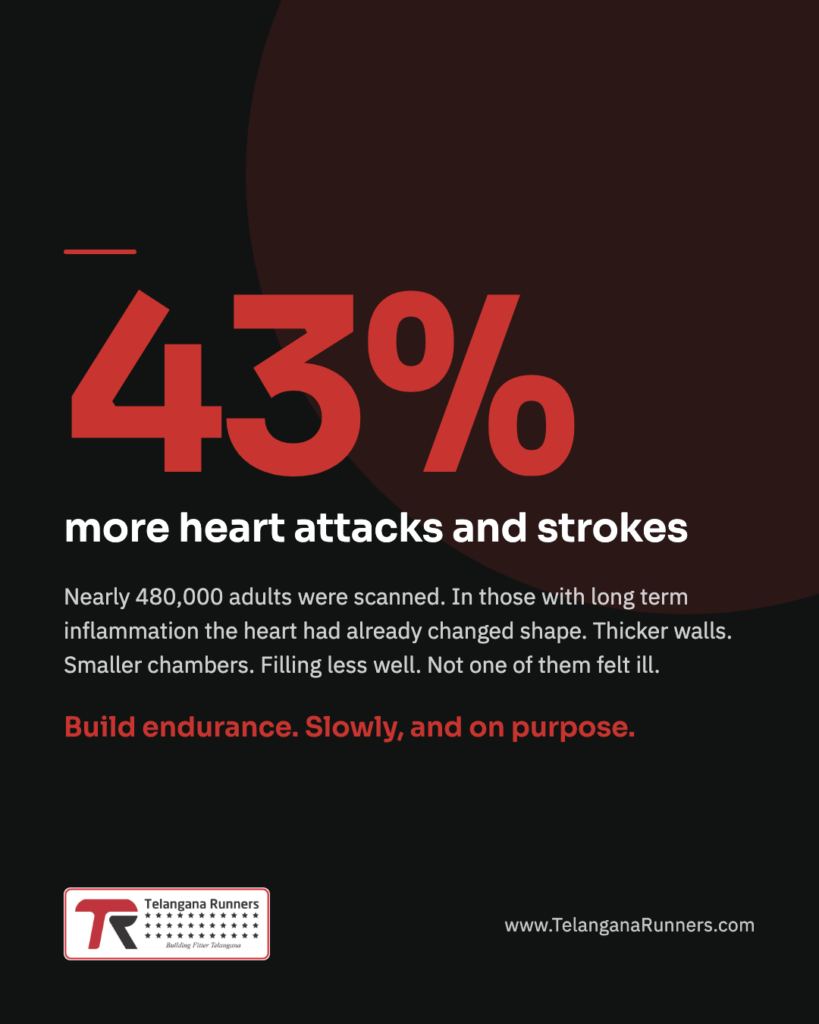
Short answer: in nearly half a million adults, long term inflammation in the blood went with hearts that had already changed shape. Thicker walls, smaller chambers, filling less well. The group with the most inflammation had a 43 per cent higher chance of a heart attack or stroke. None of them felt ill. Building endurance is the habit that acts on the things behind it.
Half a million hearts, and nobody felt a thing
Researchers looked at the hearts of nearly 480,000 adults. They measured a marker in the blood called GlycA, which goes up when the body has been inflamed for a long time. Then they looked at the heart scans.
In the people with the most inflammation, the heart had already started to change. The walls were thicker. The chambers were smaller. The heart was not filling as well as it should.
Not one of them had gone to a doctor about it. Nothing hurt.
The heart does not fail in a day. It stiffens quietly, over years, while every routine test reads normal.
What is inflammation doing in there?
Think of a cut on your hand. It goes red, it goes warm, and in a few days it is healed. That is inflammation doing its job.
Now imagine that same process turned down low and left running for twenty years. Nothing you can feel. But the lining of every blood vessel is being worn at, day after day. and the heart is quietly stiffening against the extra work.
The researchers named the two things most worth changing: smoking, and extra weight. And they said something else, plainly. Nobody is fated to get heart disease.
So what do you do about something you cannot feel?
You build endurance. Not speed. Endurance.
The heart learns to fill
Every easy run asks the heart to fill and empty, thousands of times, at a pace it can hold. A heart asked to do that most days fills better than one that is not.
The arteries learn to open
Regular aerobic work improves the way arteries relax and widen. Those linings are the first thing long term inflammation wears down, which is exactly why this matters here.
The weight comes off, and stays off
Because the effort is repeatable. Weight lost through something you can do again next week does not come back the way weight lost through something you cannot.
And none of it comes from one hard session
It comes from turning up on Sunday, and the Sunday after that.
Does it actually work? The numbers
For people who already have heart disease, this has been measured properly. Across 63 trials and 14,486 people, a supervised exercise programme brought deaths from heart disease down from 10.4 per cent to 7.6 per cent. Hospital stays fell from 30.7 per cent to 26.1 per cent.
Yet most people who could be offered such a programme never are. It is the quietest treatment in medicine.
Questions people actually ask
Can I feel my heart getting stiffer?
No. That is the whole problem. In this study of nearly 480,000 adults, the hearts had already thickened and were filling less well. The people carrying them felt perfectly well. Symptoms arrive late, after the change is done.
What is inflammation, in plain words?
It is the body switched on to defend itself. A cut goes red and warm for a few days, and that is useful. Long term inflammation is the same thing turned down low and left running for years. It wears tissue down instead of repairing it.
Does running lower inflammation?
This study did not test that. What it did show is that the two things most worth changing are smoking and extra weight. Regular endurance work acts on weight, blood pressure, sleep and the way the body handles sugar. That is why it is the habit worth building.
How much running is enough?
Enough that you can hold a conversation while you do it, most days of the week. Endurance is built by repeating an effort you can hold, not by one hard session a week.
I already have a heart problem. Is running safe for me?
Do not start alone. A person with known heart disease should train under supervision, where the effort is raised step by step and watched. That is what physician supervised, exercise based cardiac rehab is. Across 63 trials it lowered deaths from heart disease from 10.4 per cent to 7.6 per cent.
Where do I start if I have never run?
Walk first, every day, until thirty minutes feels easy. Then add short runs inside the walk. Come to a Sunday run and start at the back; nobody there is watching your pace.
Start where you are
You cannot feel your heart getting stiffer. You can feel yourself running a little further than you could last month. That is the whole of it.
We run on Sunday mornings and nobody is watching your pace.
Where these numbers come from
The heart scan study: European Journal of Preventive Cardiology, September 2026, nearly 480,000 UK adults. The exercise numbers: a Cochrane review of exercise based cardiac rehab in coronary heart disease, 63 trials and 14,486 people.
Dr Muralidar Babi, MBBS, MD (CMC Vellore)
Cardiac Rehab Physician
Founder Cardiac Rehab and Telangana Runners
TGMCI Reg. No. 59309