


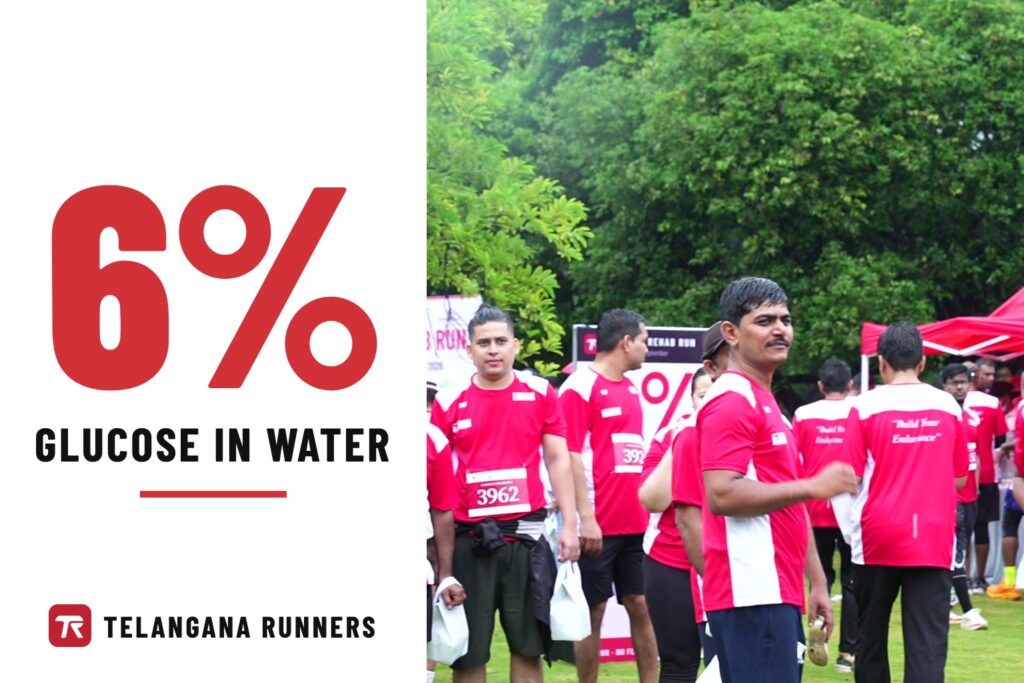
Walk up to the hydration stall at any Telangana Runners run and you will find a drink with no colour and no flavour. It is not plain water. It is glucose in water, mixed to one exact number: 6%.
People ask us why we go to that trouble. The short answer: at our runs we do things the way the science says, not the way habit says.
What 6% actually means
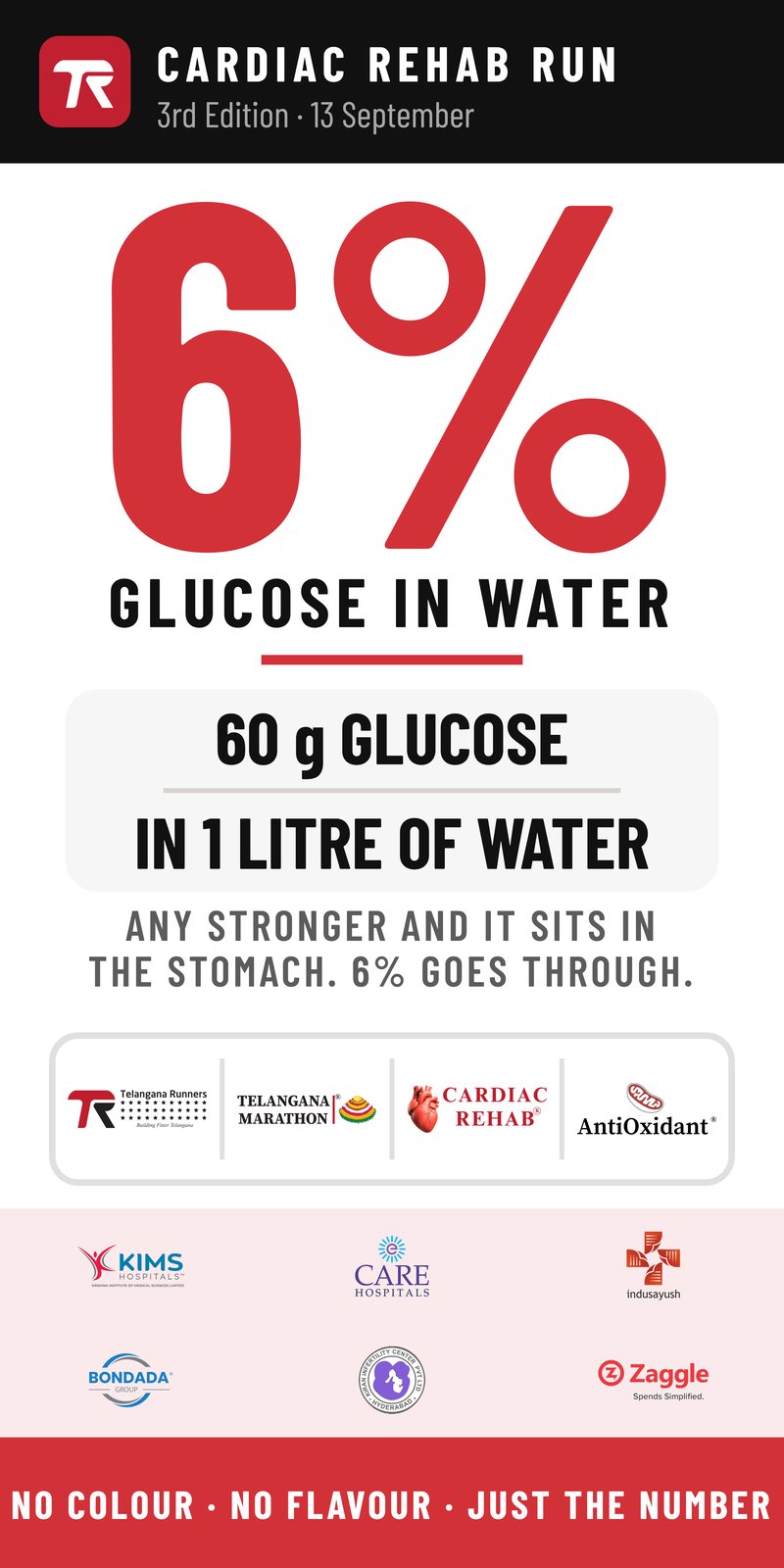
6% means 6 grams of glucose in every 100 millilitres of water. Mix 60 grams of glucose into 1 litre of water and you have it.
That is the whole recipe. No colour. No flavour. Just the number.
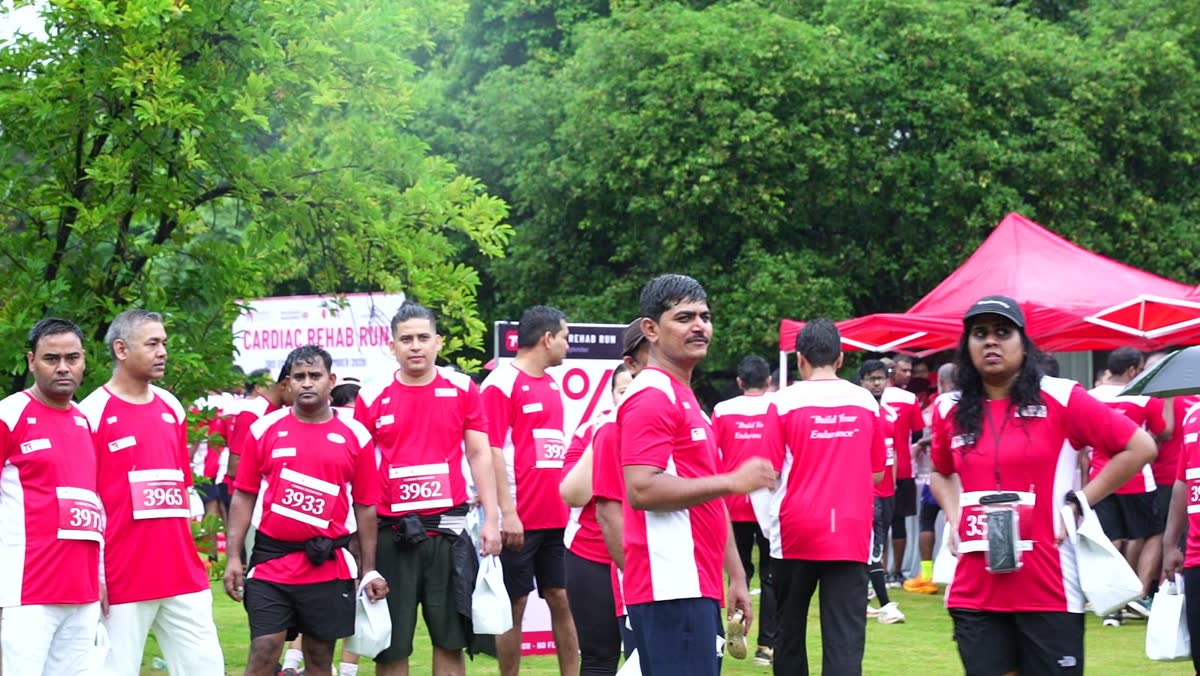
At the Cardiac Rehab Run 2026, our 3rd Edition, on Sunday 13 September at Sanjeevaiah Park and Necklace Road, we printed the recipe on a 3 by 6 foot board and stood it at the drinks stall. The board said:
6% GLUCOSE IN WATER
60 g GLUCOSE IN 1 LITRE OF WATER
ANY STRONGER AND IT SITS IN THE STOMACH. 6% GOES THROUGH.
NO COLOUR · NO FLAVOUR · JUST THE NUMBER
We wanted every runner to see the number, and take the recipe home.
Why your body needs glucose on a long run
Your muscles run on fuel. Part of that fuel is glucose from your blood, and part is glycogen, which is glucose your body stores in the muscles and liver.
On a short run, those stores are plenty. Water is enough. But as an effort goes on, the stores run down. When they get low, legs feel heavy, pace drops, and thinking gets foggy. Runners call it hitting the wall.
A little glucose taken during a long effort helps keep blood sugar steady and the muscles supplied. The International Society of Sports Nutrition says that for long, hard sessions, people should take about 30 to 60 grams of carbohydrate an hour, in a 6 to 8% drink, a few sips every 10 to 15 minutes. The American College of Sports Medicine agrees that during exercise, drinks with carbohydrate and salts can do more than water alone in some situations.
Why 6%, and not more
This is the part most people get wrong. More sugar is not better.
Before a drink can help you, it has to leave your stomach and be absorbed. A stronger, sweeter drink leaves the stomach more slowly. It sits there. That is when runners feel full, sloshy or sick, and the fluid is slow to reach the body that needs it.
Researchers have measured this. In one study, cyclists drank water, or drinks with 4%, 6% or 8% carbohydrate, every 15 minutes for 90 minutes. The 8% drink left the stomach clearly more slowly. The 4% and 6% drinks did not slow it down.
A second study looked at the other side. It compared 6%, 3% and plain water during exercise. All three left the stomach and were absorbed as fast as each other. But the 6% drink delivered more carbohydrate into the body and kept blood glucose higher.
So 6% sits at a sweet spot. It is strong enough to bring real fuel, and weak enough to pass through like water. That is exactly what the board meant by “any stronger and it sits in the stomach. 6% goes through.”
Why this makes our runs different
Most events hand out whatever drink is easiest to buy. We decided to pour a number instead.
This is not a gimmick. It comes straight from what Telangana Runners is for. Our vision, as it stands on our website, is:
“To make Telangana the fittest state in India, by building endurance in 33 districts, preventing the rising trend of obesity, diabetes, hypertension, heart attacks and other lifestyle diseases.”
We describe ourselves as India’s first scientific institute dedicated to building endurance. One of our five pillars is Sports Research and Innovations, and in our own words we treat running “not as a trend but as a science.”
A science is not only a slogan on a banner. It shows up in small things, like how many grams of glucose go into a litre of water. That is why we served 6% glucose at the Cardiac Rehab Run, and why we will keep serving it at all our runs.
The bottom line
A few simple cautions. 6% glucose is a tool for long efforts. It is not a health drink to sip all day.
- Short, easy runs: plain water is usually enough.
- Long or hard runs: small sips of 6% glucose along the way can help.
- If you have diabetes, glucose will raise your blood sugar. Talk to your doctor about how and when to use it before a long run.
- Try it in training first. Race day is not the day to try anything new.
Sixty grams of glucose. One litre of water. Enough fuel to help, not so much that it sits in your stomach. It is one small number, and it is how we want every part of our runs to work: measured, simple, and backed by evidence.
Come and taste the number for yourself at our next run. Find the next run and join us at www.TelanganaRunners.com.
References
- Kerksick CM, Arent S, Schoenfeld BJ, et al. International Society of Sports Nutrition position stand: nutrient timing. Journal of the International Society of Sports Nutrition. 2017;14:33. https://pmc.ncbi.nlm.nih.gov/articles/PMC5596471/
- Murray R, Bartoli W, Stofan J, Horn M, Eddy D. A comparison of the gastric emptying characteristics of selected sports drinks. International Journal of Sport Nutrition. 1999;9(3):263-274. https://pubmed.ncbi.nlm.nih.gov/10477362/
- Rogers J, Summers RW, Lambert GP. Gastric emptying and intestinal absorption of a low-carbohydrate sport drink during exercise. International Journal of Sport Nutrition and Exercise Metabolism. 2005;15(3):220-235. https://pubmed.ncbi.nlm.nih.gov/16131694/
- American College of Sports Medicine, Sawka MN, Burke LM, et al. Exercise and fluid replacement (position stand). Medicine & Science in Sports & Exercise. 2007;39(2):377-390. https://pubmed.ncbi.nlm.nih.gov/17277604/
Dr Muralidar Babi, MBBS, MD (CMC Vellore)
Founder, Cardiac Rehab and Telangana Runners
TGMCI Reg. No. 59309
#TelanganaRunners #TelanganaMarathon #CardiacRehab #CardiacRehabFoundation #muralidarbabi