


Think back to your last school or college reunion. There is always that one person in your batch who looks noticeably younger than everyone else. And almost everyone in the room assumes the same thing. Good genes.
It is not the genes. And the actual explanation is more uncomfortable than most people expect.
They are not ageing slower. You aged faster.
This is the reframe that changes everything. That person is not defying time. They are ageing on schedule, at the rate a human body is supposed to age. What you are looking at is not exceptional youth. It is your own premature ageing, standing in contrast.
Premature ageing is not inevitable. It is accelerated. And what accelerates it is worth understanding.
Ageing is largely a process of oxidative damage
Every time your body produces energy, it also produces free radicals. Over years, these unstable molecules damage cells, proteins and DNA throughout the body, including the skin. This is the oxidative theory of ageing, and it is why the wellness market is saturated with antioxidant supplements.
The logic behind those supplements is sound. The delivery method is where it falls apart.
The paradox: exercise causes oxidative stress, and that is exactly why it works
Here is the part that seems contradictory at first. Exercise increases oxidative stress. A hard endurance session floods your system with exactly the free radicals you are trying to avoid.
But your body does not simply absorb that damage. It adapts to it. Your muscles respond to repeated oxidative stress by upregulating their own antioxidant enzymes, building a stronger internal defence system than they had before. A twelve week endurance training study in healthy older adults found a measurable improvement in superoxide dismutase activity, one of the body’s primary antioxidant enzymes.
The stress is not the problem. The stress is the stimulus.
The evidence reaches your skin
This is where the research becomes genuinely striking. Researchers at McMaster University took skin biopsies from the buttock, deliberately choosing skin never exposed to sun so that sun damage could not confound the result.
Adults over forty who exercised regularly had markedly thinner stratum corneum and thicker dermis, with skin composition resembling that of people in their twenties and thirties.
The team then went further. They took sedentary adults aged sixty five and above, had them jog or cycle for thirty minutes twice a week at moderate intensity for twelve weeks, and re-examined the tissue. The skin structure had shifted measurably back toward that younger range.
This was not a survey or a self reported questionnaire. It was measured under a microscope.
A supplement is a dose. Endurance is a structure.
Vitamin C has an elimination half life of roughly ten hours. It enters your bloodstream, peaks, and clears. That is precisely why it is sold as a daily tablet. Tomorrow you begin again from zero.
What your muscles build is a different category of thing entirely. It is not a dose passing through your bloodstream. It is structural, embedded in your tissue, and rebuilt every time you train.
A supplement is something you keep buying. Endurance is something you own.
Q&A
Does exercise really slow down ageing, or does it just make you look fitter?
Both, but the skin finding is structural rather than cosmetic. Biopsied skin from regular exercisers over forty showed composition closer to that of people two decades younger, measured in tissue rather than appearance.
How much exercise did the skin study actually require?
Thirty minutes of jogging or cycling at moderate intensity, twice a week, for twelve weeks. That is a modest commitment for a measurable structural change.
If exercise creates oxidative stress, isn’t it damaging me?
Acutely, yes. But the adaptation to that stress is the point. Your body responds by building stronger antioxidant defences than it had before, a process known as hormesis.
Should I take antioxidant supplements alongside training?
This is worth discussing with your doctor. Some research suggests high doses of certain antioxidant supplements may blunt the very training adaptations you are working for, though findings are mixed.
Is it too late to start if I am already over sixty?
The skin study specifically recruited previously sedentary adults aged sixty five and above, and still measured a shift toward younger tissue composition after twelve weeks.
The bottom line
The person at your reunion who looks younger is not lucky. In most cases they have simply spent years asking their body to defend itself, and their body obliged.
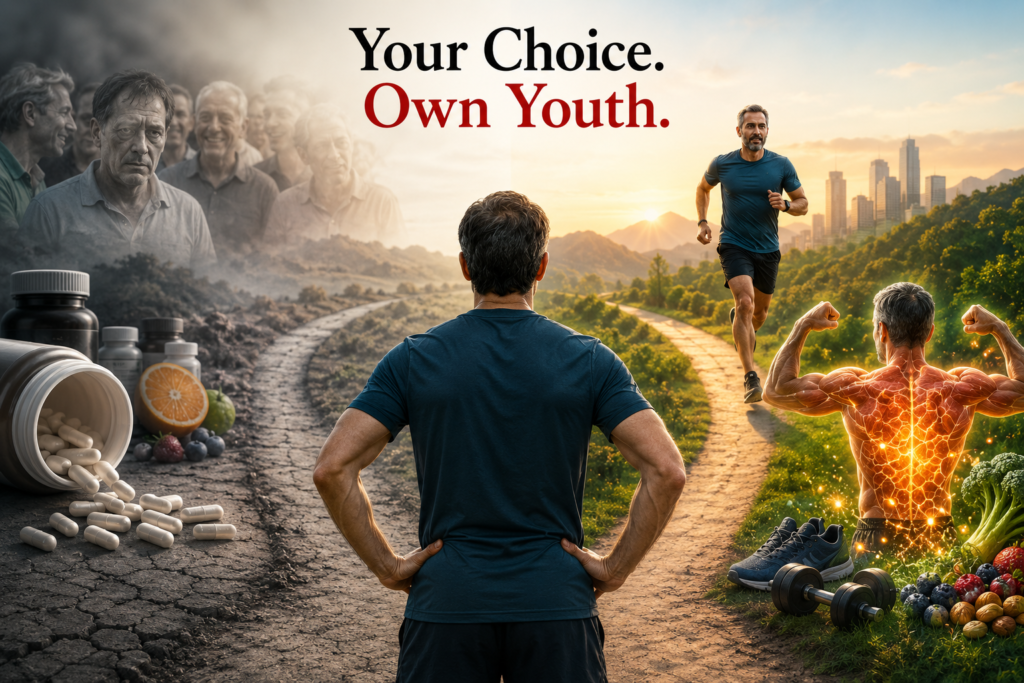
So to stay young, what is your choice? Swallow antioxidants every single day, or build endurance and keep it?
If you are building an endurance base or recovering from a cardiac event, the Cardiac Rehab Run is built on exactly this evidence based approach. Read about cardiac rehab | Join the next Cardiac Rehab Run
References
Crane JD, MacNeil LG, Lally JS, et al. Exercise-stimulated interleukin-15 is controlled by AMPK and regulates skin metabolism and aging. Aging Cell, McMaster University.
Effect of endurance exercise training on plasma superoxide dismutase activity in healthy elderly subjects.
Clinical pharmacokinetics of vitamin C: elimination half life in plasma.
Dr Muralidar Babi, MBBS, MD (CMC Vellore)
Founder, Cardiac Rehab and Telangana Runners
TGMCI Reg. No. 59309