


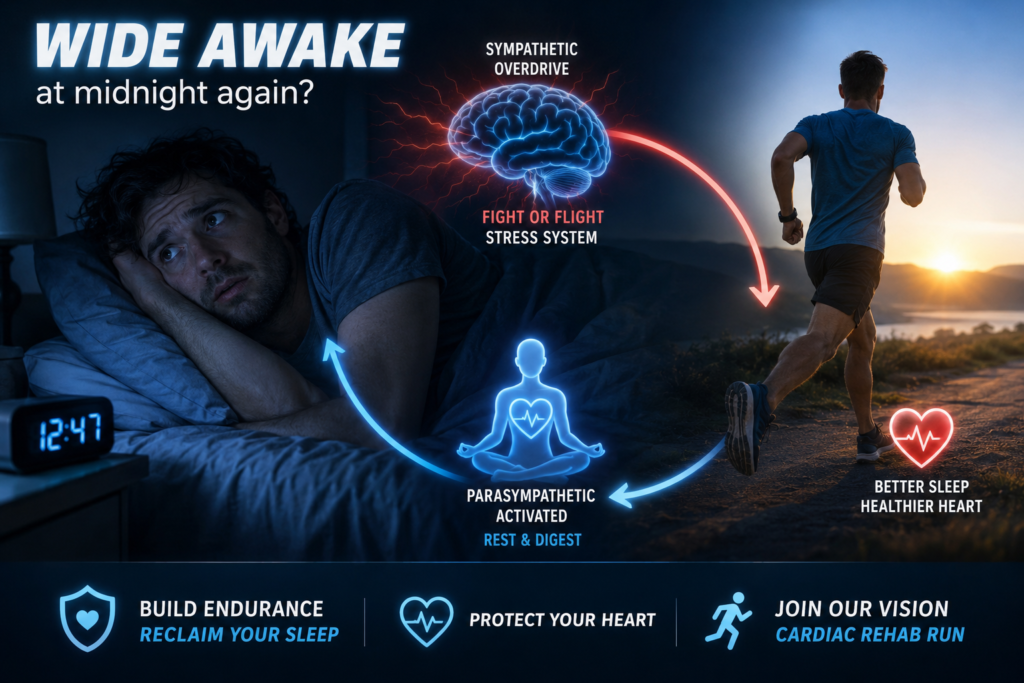
You are exhausted all day. Then the lights go off, your head hits the pillow, and your brain refuses to switch off. If this is your nightly pattern, the problem is not that you need more rest. The problem is which nervous system is running the show.
The system keeping you alert is the one blocking your sleep
Your sympathetic nervous system, the fight or flight response, is what keeps you alert, focused and reactive through a demanding day. That is its job. The trouble begins when it never stands down. Under chronic stress, sympathetic activity stays elevated around the clock, and it does not obligingly switch off at bedtime. You feel tired, but physiologically your body is still braced for action, which is why restful, uninterrupted sleep becomes so hard to reach.
To remove a needle, you need another needle
Most people respond to this by trying to rest harder. More lying down, more screen time in bed, more effort to relax. It rarely works, because rest is not what breaks a stress loop.
There is an old idea that captures the solution precisely: to remove a needle, you need another needle. The way out of chronic stress is a controlled dose of the right kind of stress. And that is exactly what exercise is.
The paradox: acute versus chronic
Here is where it gets counterintuitive. A single workout does stimulate your sympathetic nervous system. In the moment, exercise raises stress, not lowers it. This is why the paradox confuses people.
But look at what happens over months rather than minutes. Long term endurance training increases parasympathetic activity and decreases sympathetic activity in the human heart at rest. The short term spike is the very stimulus that drives the long term adaptation. Each session nudges the system, and over time your resting autonomic balance shifts in the opposite direction to where it started.
What the data actually shows
The effect size here is not subtle. In a study measuring resting heart rate variability, a direct index of parasympathetic tone, six months of aerobic exercise training raised HRV by 17% in young adults and by 68% in older adults. The authors concluded that exercise training increases parasympathetic tone at rest, which may contribute to the reduction in mortality associated with regular exercise.
Notably, older adults gained the most. Parasympathetic control of the heart naturally declines with age, and regular endurance exercise measurably slows that decline.
Why your heart cares about your sleep
This is not simply about waking up refreshed. A meta analysis of 17 studies covering more than 500,000 participants found a U shaped relationship between sleep duration and coronary heart disease, with the lowest risk at seven to eight hours per night. Compared with seven hours, coronary heart disease risk rises approximately 11% for each hour of sleep lost.
Sleep is not a luxury sitting outside your cardiovascular risk profile. It is inside it.
Q&A
Why does exercise help sleep if it is itself a stressor?
A single session briefly raises sympathetic activity, but consistent training over months raises parasympathetic tone at rest and suppresses chronic sympathetic overdrive. The short term stress is what drives the long term adaptation.
How long before it makes a difference to my sleep?
The measurable autonomic adaptations in the research were assessed over six months of consistent aerobic training. This is a slow structural change, not an overnight fix.
Does the timing of my workout matter?
Because acute exercise raises sympathetic activity temporarily, very late high intensity sessions may delay sleep onset for some people. If you find this happening, shift your harder sessions earlier in the day.
Is short sleep really a cardiovascular risk factor?
Large cohort meta analyses consistently associate sleep below seven hours with increased coronary heart disease risk, roughly 11% per hour lost. These are observational associations, so they show a strong link rather than proving direct causation.
Does this apply to older adults too?
Yes, and arguably more so. Older adults showed the largest gain in parasympathetic tone, a 68% increase in resting HRV after six months of training.
The bottom line
You are not wearing your body out when you train. You are giving your brain the biological permission to finally shut down.
If you are building an endurance base or recovering from a cardiac event, the Cardiac Rehab Run is built on exactly this evidence based approach. Read about cardiac rehab | Join the next Cardiac Rehab Run
References
Yamamoto K, Miyachi M, Saitoh T, et al. Effect of endurance exercise on autonomic control of heart rate. Sports Medicine, 2003.
Levy WC, Cerqueira MD, Harp GD, et al. Effect of endurance exercise training on heart rate variability at rest in healthy young and older men. American Journal of Cardiology, 1998.
Wang D, Li W, Cui X, et al. Sleep duration and risk of coronary heart disease: A systematic review and meta-analysis of prospective cohort studies. International Journal of Cardiology, 2016.
Dr Muralidar Babi, MBBS, MD (CMC Vellore)
Founder, Cardiac Rehab and Telangana Runners
TGMCI Reg. No. 59309