


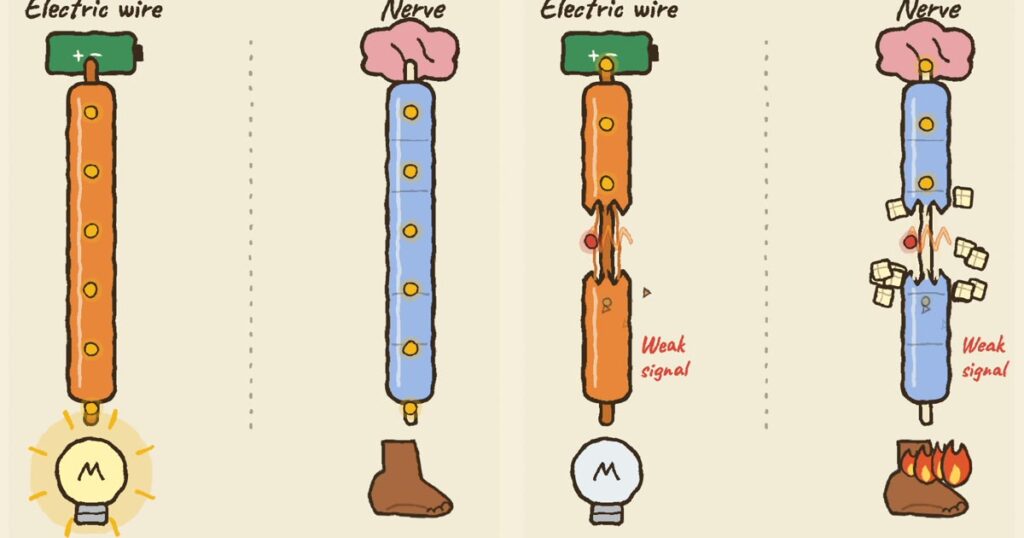
Short answer: Burning feet after a walk or a run? High blood sugar can damage the cover of a nerve, much like worn insulation on a wire, and the signal turns weak and abnormal. Pain medicines can calm the burning, while walking and running work on the sugar itself: structured exercise lowered HbA1c by 0.67 points in 47 trials.
The short version
- Diabetic neuropathy affects about 10% of people with diabetes at diagnosis and 40% to 50% after 10 years (Cochrane review).
- A nerve works like an electric wire: when its cover is damaged, the signal turns weak and abnormal.
- Structured exercise lowered HbA1c by 0.67 points in 47 trials with 8,538 people with type 2 diabetes.
- In type 2 diabetes, tighter sugar control lowered neuropathy risk less clearly than in type 1 (0.58 vs 1.84 points a year).
- In a pilot study of 17 people with neuropathy, 10 weeks of supervised exercise eased nerve pain.
Burning feet are a nerve signal gone wrong
Burning in the feet with nothing touching them is a common sign of diabetic neuropathy, which means damage to the nerves. In diabetes it usually starts in the feet and the legs. A Cochrane review reports that diabetic neuropathy affects about 10% of people with diabetes when they are diagnosed and 40% to 50% after 10 years. People describe burning, tingling or pain that is often worse at night.
The nerve is sending signals that do not match what is happening in the foot. That is why a bed sheet can feel painful, or a foot can burn in a cool room. The same nerves also carry the feeling of touch, so a foot with damaged nerves can miss a small cut or a blister. This is why numb feet need care, and why the cause is worth finding early.
A wire, a cover and a weak spot
Think of a nerve as an electric wire. A wire carries current from a battery to a bulb, and a nerve carries signals between your brain and your foot. Both need a smooth cover to keep the signal clean, called insulation in a wire and myelin in a nerve. Schwann cells, the cells that wrap the nerve fibres, make and look after that cover.
When the cover of a wire is damaged in one place, the current sputters at that spot and a bulb on the line blinks on and off. When the cover of a nerve is damaged, the signal also turns weak and abnormal at that spot. Your foot then reports burning or tingling that no touch has caused. The drawing below shows the same break in both.
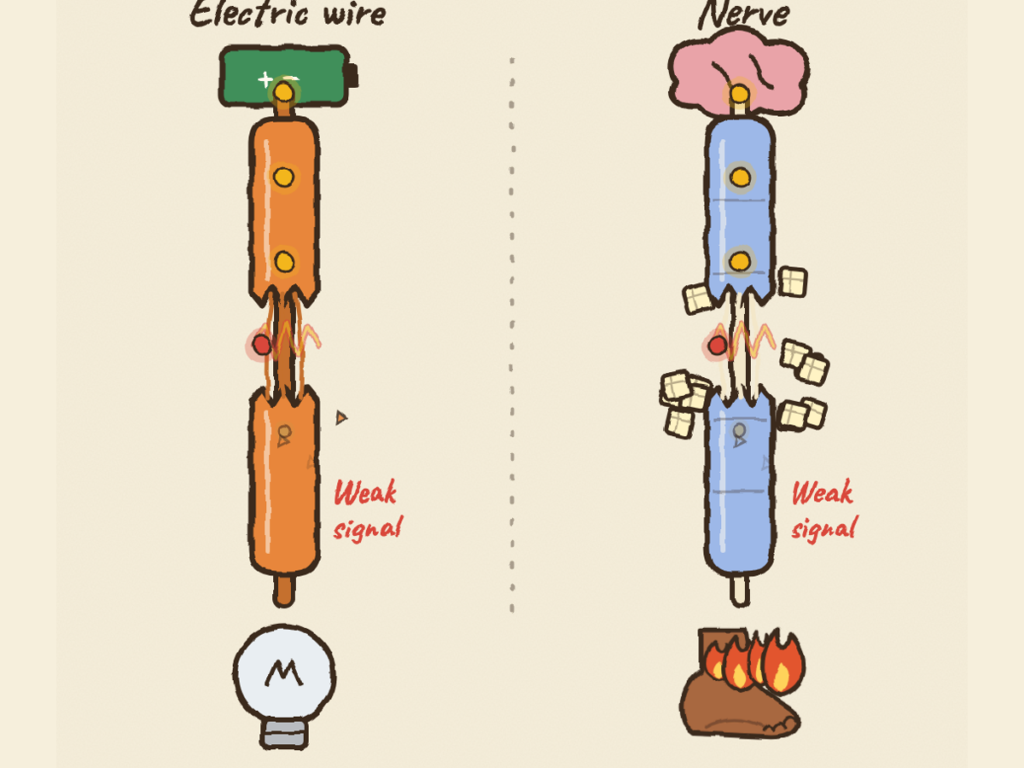
How does sugar damage the cover? A review of aldose reductase describes one route. In high blood sugar, extra glucose flows through the polyol pathway inside Schwann cells, and this has been suggested to play a critical role in diabetic neuropathy. The same review says the importance of that route is still not settled. Researchers are still working out which routes matter most, but they agree that high sugar and nerve damage go together.
Where blood sugar comes in
If sugar damages the nerve, lowering it should protect the nerve, and the best evidence comes from trials of tighter glucose control. A Cochrane review pooled these trials. In type 1 diabetes, tighter control lowered the yearly risk of clinical neuropathy by 1.84 percentage points in 1,228 people. In type 2 diabetes the drop was 0.58 points in 6,669 people, and the authors called it not formally statistically significant (P = 0.06).
The review also found that tighter control significantly reduced nerve conduction and vibration threshold problems in both types. It found more severe low-sugar episodes as well, so sugar targets should be set with your doctor. Lowering sugar helps the nerve, but in type 2 diabetes the benefit is smaller and less certain than many people expect. This is why we make no big promises about burning feet.
Walking and running work on the sugar
Pain medicines can calm the signal. Walking and running go after the sugar itself, because working muscles take sugar out of the blood. A review of 47 trials with 8,538 people with type 2 diabetes compared structured exercise with no structured exercise. Structured exercise lowered HbA1c, the three-month sugar average, by 0.67 points (95% confidence interval 0.49 to 0.84).
Aerobic training lowered HbA1c by 0.73 points, resistance training by 0.57 points, and both together by 0.51 points. Programmes of more than 150 minutes a week were linked to a drop of 0.89 points, against 0.36 points for 150 minutes or less. Advice to be more active did not change HbA1c unless it came with diet advice. The studies differed a lot from one another, so these are averages and not a promise for one person.
A small study on nerve pain
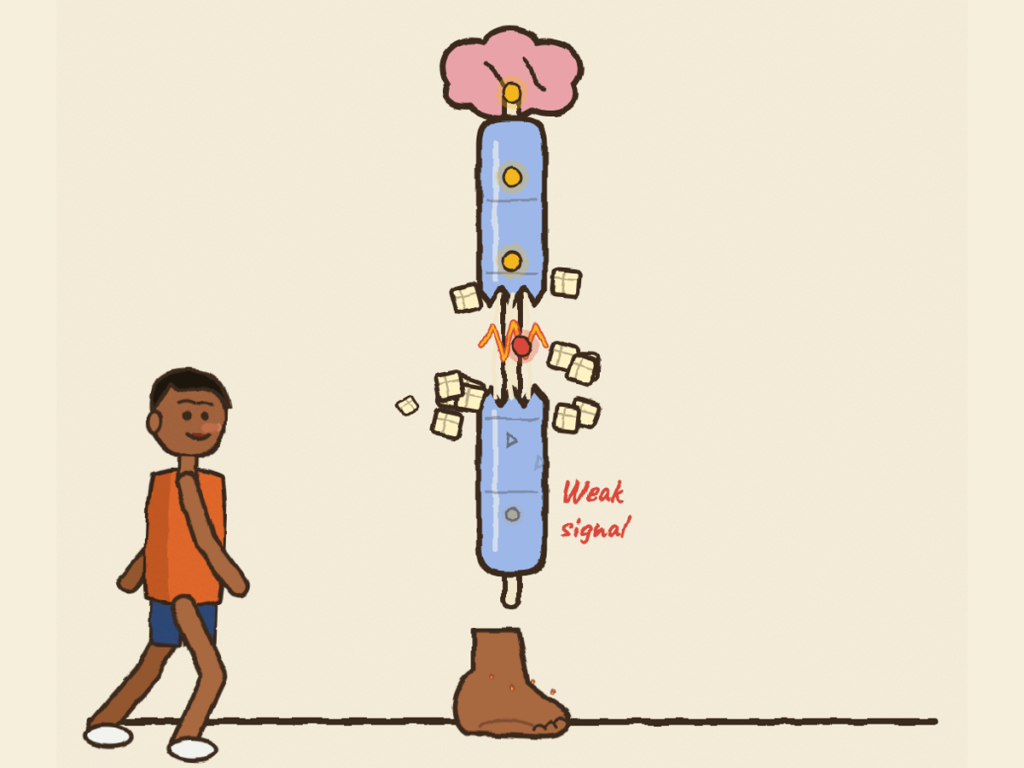
A small pilot study asked this question in 17 people with diabetic peripheral neuropathy. They did a supervised programme of aerobic and strength exercise for 10 weeks. Pain fell by 18.1 mm on a 100 mm scale (P = .05), and a neuropathy symptom score fell by 1.24 points (P = .01). Skin biopsies showed more branching of the small nerve fibres at one site (P = .008).
This study had no control group, so we cannot say the exercise caused the change. The authors say the findings need to be checked against a control group in future studies. It is a first and encouraging signal, not proof. We say that exercise eased pain in a small study, and we do not say that it reverses nerve damage.
How to start
If you have diabetes and burning feet, see your doctor first. Diabetic neuropathy has other causes and other treatments, and your doctor can check your sugar, your feet and your medicines. Pain medicines can calm the burning, while walking and running work on the sugar and may ease the pain over weeks.
Start with easy walks and add time slowly, as the 10% rule for runners also says. If your feet are numb, ask your doctor before you start, look at your feet after every walk, and wear shoes that fit. Building endurance one easy step at a time is the aim.
Your questions, answered
Why do my feet burn when nothing touches them?
Burning without touch is a common sign of diabetic neuropathy, which is damage to the nerves of the feet. The damaged nerve sends signals that do not match what is happening in the foot. A Cochrane review reports that it affects about 10% of people with diabetes at diagnosis and 40% to 50% after 10 years. See your doctor, because other causes need other treatment.
Can exercise reverse diabetic neuropathy?
No study shows that it can. In a small pilot study of 17 people, 10 weeks of supervised exercise eased pain and a symptom score, and more nerve branching was seen in a skin biopsy at one site. The study had no control group, so the cause of the change is not proven.
How much does exercise lower blood sugar?
In a review of 47 trials with 8,538 people with type 2 diabetes, structured exercise lowered HbA1c by 0.67 points. More than 150 minutes a week was linked to a bigger drop, 0.89 points, than 150 minutes or less, 0.36 points. The studies differed a lot from one another.
Does tighter sugar control prevent neuropathy?
It helps, but less clearly in type 2 diabetes. A Cochrane review found a clear drop in clinical neuropathy in type 1 diabetes and a smaller drop in type 2 that was not formally significant (P = 0.06). It also found more severe low-sugar episodes, so set targets with your doctor.
Build Your Endurance Now
Walk or jog most days and build up slowly. Read the heart side on Cardiac Rehab: burning feet in diabetes.
References
- Callaghan BC, Little AA, Feldman EL, Hughes RAC. Enhanced glucose control for preventing and treating diabetic neuropathy. Cochrane Database Syst Rev. 2012;(6):CD007543. pubmed.ncbi.nlm.nih.gov/22696371
- Umpierre D, Ribeiro PAB, Kramer CK, et al. Physical activity advice only or structured exercise training and association with HbA1c levels in type 2 diabetes: a systematic review and meta-analysis. JAMA. 2011;305(17):1790-1799. pubmed.ncbi.nlm.nih.gov/21540423
- Kluding PM, Pasnoor M, Singh R, et al. The effect of exercise on neuropathic symptoms, nerve function, and cutaneous innervation in people with diabetic peripheral neuropathy. J Diabetes Complications. 2012;26(5):424-429. pubmed.ncbi.nlm.nih.gov/22717465
- Niimi N, Yako H, Takaku S, Chung SK, Sango K. Aldose reductase and the polyol pathway in Schwann cells: old and new problems. Int J Mol Sci. 2021;22(3):1031. pubmed.ncbi.nlm.nih.gov/33494154