


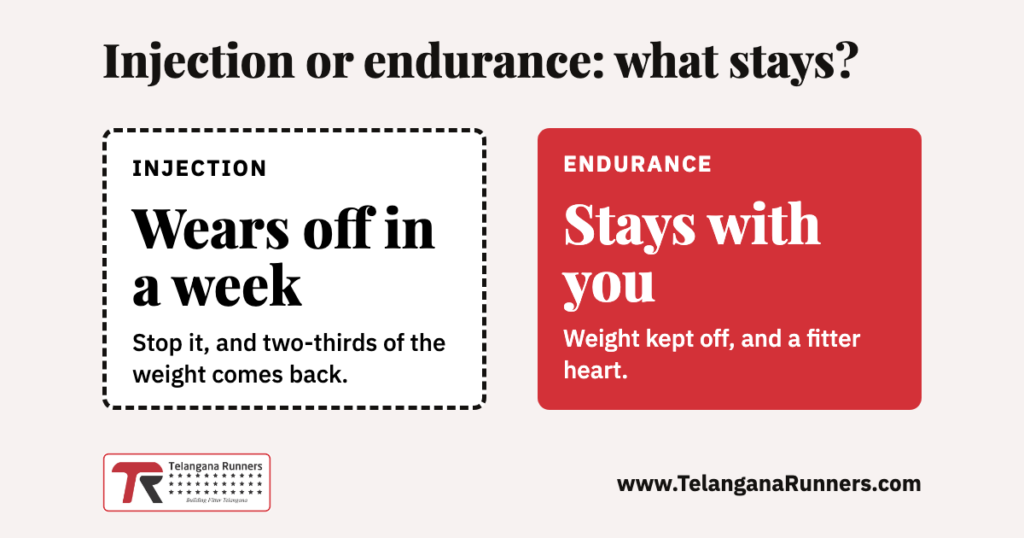
Short answer: A weight loss injection and endurance running both lower hunger in the same part of the brain. Both bring weight down. The difference shows when you stop. One year after stopping the injection, two-thirds of the lost weight came back. In one trial, people who stopped their exercise programme kept most of the weight off.
The short version
- The injection copies a fullness hormone. Running makes your body change its own.
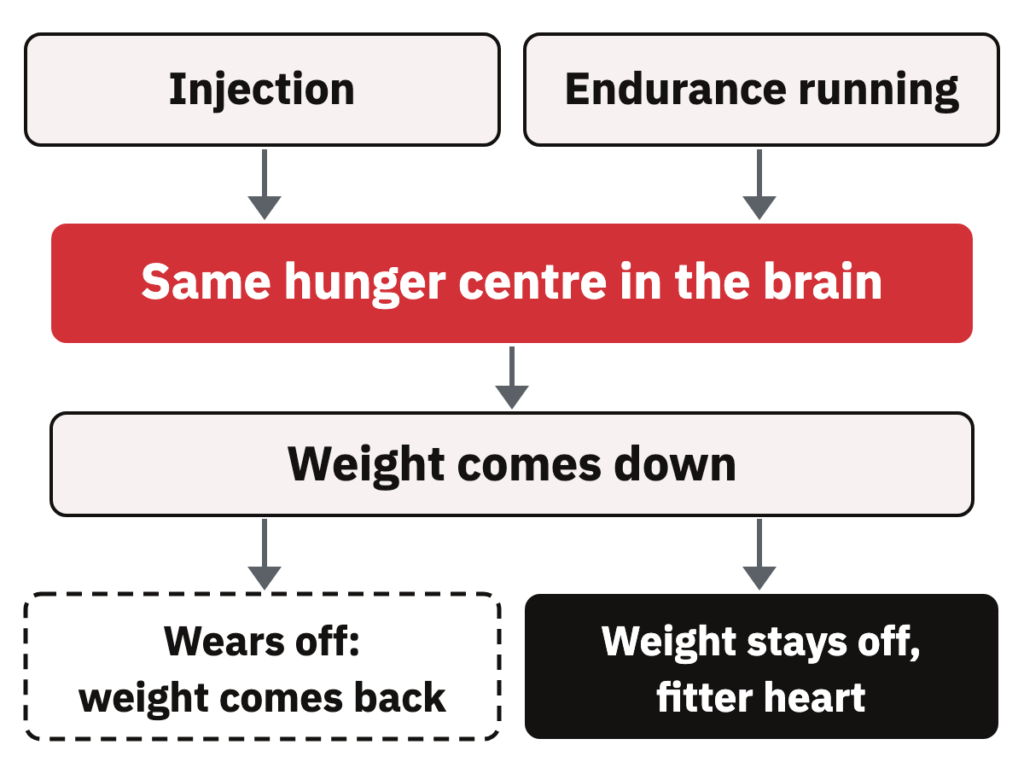
- Both work on the hunger centre of the brain.
- Two-thirds of the lost weight came back a year after stopping the injection.
- In one trial, 9.6 kg came back after the injection and 3.6 kg after exercise.
- Fitness also lowers the risk of heart disease, diabetes and high blood pressure.
How does a weight loss injection work?
The injection is a copy of GLP-1, a fullness hormone your gut already makes. The FDA label says it works on the parts of the brain that control hunger, and it slows down the stomach. So you feel less hungry and eat less. But each dose wears off, and half of it is gone in about a week.
How does endurance running lower hunger?
Long, easy runs make your body change its own hunger hormones. In 20 studies, one session lowered the hunger hormone ghrelin by about 16% and raised the fullness hormone PYY by about 9%. Both hormones act on the same hunger centre in the brain as the injection. And with weeks of training, you feel full sooner after a meal.
What happens after you stop?
This is where the roads split. One year after people stopped semaglutide, two-thirds of the weight they lost had come back. In a trial in Copenhagen, people regained 9.6 kg in the year after stopping liraglutide. People who stopped their exercise programme regained 3.6 kg, and the authors say their weight was maintained.
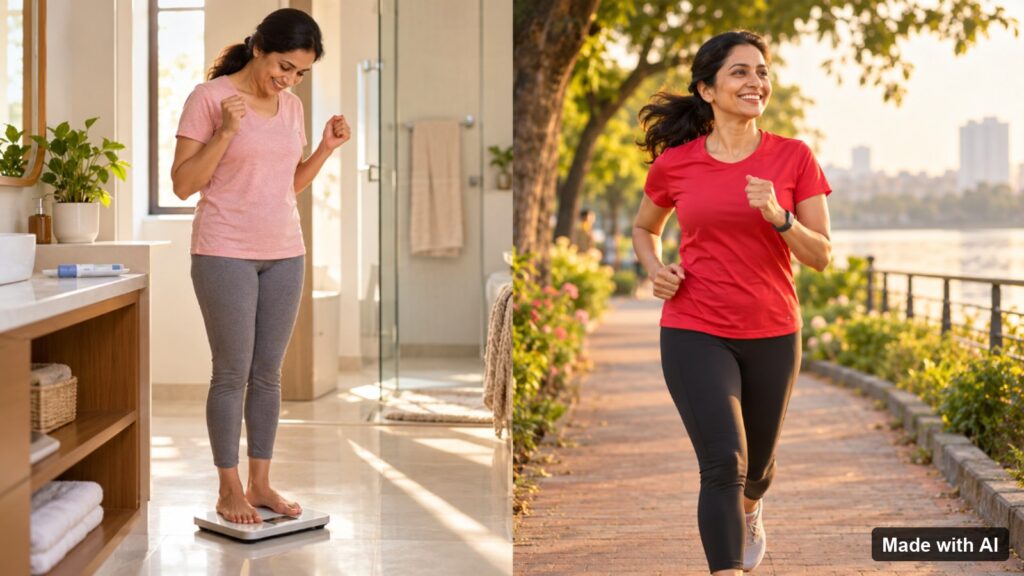
A review of 37 studies found that after stopping weight loss medicines, weight was predicted to be back to the start in 1.7 years. After diet and exercise programmes, it took 3.9 years. Quick results come back. The endurance you build stays with you.
What do you gain besides weight?
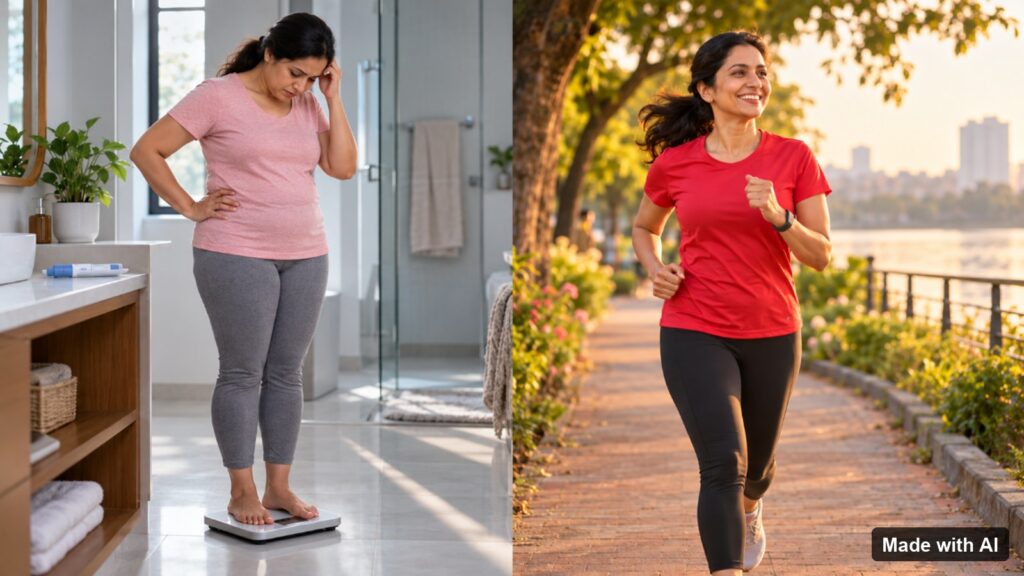
You build a fitter heart. In 33 studies, each step up in fitness, about 1 km per hour faster running, came with 15% fewer heart events. The same step came with 10% lower risk of type 2 diabetes and 8% lower risk of high blood pressure. You can also run, play and move more, which makes every day easier.
Should anyone start with the injection?
Yes, some people should. People with heart disease and overweight, obesity, sleep apnoea or type 2 diabetes may need it first, and their doctor decides. Even then, the labels say it goes with less food and more activity. For most people, building endurance is the place to start.
Your questions, answered
Does weight come back after stopping the injection?
Yes, for most people. One year after stopping semaglutide, people in the STEP 1 trial had gained back about two-thirds of the weight they lost. The medicine leaves the body, and the hunger comes back with it. That is why the labels describe it as long-term treatment.
Does running make you less hungry?
Yes, for a while after each run. Running lowers the hunger hormone ghrelin and raises the fullness hormone PYY. Both work on the hunger centre of the brain. Over weeks of training, your body also feels full sooner after a meal. Run regularly, because the effect builds with the habit.
Is running better than the injection for keeping weight off?
In one trial, yes. People regained 9.6 kg in the year after stopping liraglutide and 3.6 kg after stopping exercise. While people are taking it, the injection can bring weight down more. But running keeps working because you keep the fitness you built.
How do I start building endurance?
Start slow and steady. Walk briskly, then mix in easy running, a few times a week. Run at a pace where you can still talk. Running with others helps you keep going. If you have heart disease, diabetes or high blood pressure, see a doctor first, ideally for a physician supervised exercise programme.
Build your endurance
Build Your Endurance Now, one easy run at a time. Telangana Runners is a non-profit building a peaceful Telangana through the discipline of sport, at www.TelanganaRunners.com. Have a heart condition or a health problem? Ask your doctor first, and read about physician supervised exercise in Weight loss injections or aerobic endurance: which one lasts? on CardiacRehab.com.
References
- FDA. WEGOVY (semaglutide) injection, prescribing information (sections 1, 12.1, 12.2, 12.3). dailymed.nlm.nih.gov/dailymed/search.cfm?query=wegovy
- Schubert MM, et al. Acute exercise and hormones related to appetite regulation: a meta-analysis. Sports Med. 2014. pubmed.ncbi.nlm.nih.gov/24174308
- Nakazato M, et al. A role for ghrelin in the central regulation of feeding. Nature. 2001. pubmed.ncbi.nlm.nih.gov/11196643
- Batterham RL, et al. Gut hormone PYY(3-36) physiologically inhibits food intake. Nature. 2002. pubmed.ncbi.nlm.nih.gov/12167864
- Wilding JPH, et al. Weight regain and cardiometabolic effects after withdrawal of semaglutide: the STEP 1 trial extension. Diabetes Obes Metab. 2022. pubmed.ncbi.nlm.nih.gov/35441470
- Jensen SBK, et al. Healthy weight loss maintenance with exercise, GLP-1 receptor agonist, or both combined followed by one year without treatment. eClinicalMedicine. 2024. pubmed.ncbi.nlm.nih.gov/38544798
- West S, et al. Weight regain after cessation of medication for weight management: systematic review and meta-analysis. BMJ. 2026. pubmed.ncbi.nlm.nih.gov/41500720
- Kodama S, et al. Cardiorespiratory fitness as a quantitative predictor of all-cause mortality and cardiovascular events in healthy men and women: a meta-analysis. JAMA. 2009. pubmed.ncbi.nlm.nih.gov/19454641
- Qiu S, et al. Association between cardiorespiratory fitness and risk of type 2 diabetes: a meta-analysis. Obesity. 2019. pubmed.ncbi.nlm.nih.gov/30604925
- Cheng C, et al. The association of cardiorespiratory fitness and the risk of hypertension: a systematic review and dose-response meta-analysis. J Hum Hypertens. 2022. pubmed.ncbi.nlm.nih.gov/34168273