



Short answer: At our runs there is no cash prize, no pacer, and no 1st, 2nd or 3rd place promised. Every finisher gets the same gift. People ask why, before every run. Here is the answer, from the person who set the rule.
The short version
- Speed and rapid progression are the biggest problem in running. They land in injuries.
- New runners get injured 2.3 times more often per hour than regular runners: 17.8 injuries per 1,000 hours against 7.7.
- An injury delays your progress, can push you back to a sedentary life, and raises your medical bills.
- Our goal is endurance for every person in Telangana: 30 minutes or more of steady effort, kept up for life.
- So we do not reward speed. No cash prize, no pacers, no podium promised. The only person to compete with is you.
What is the goal, if not a race?
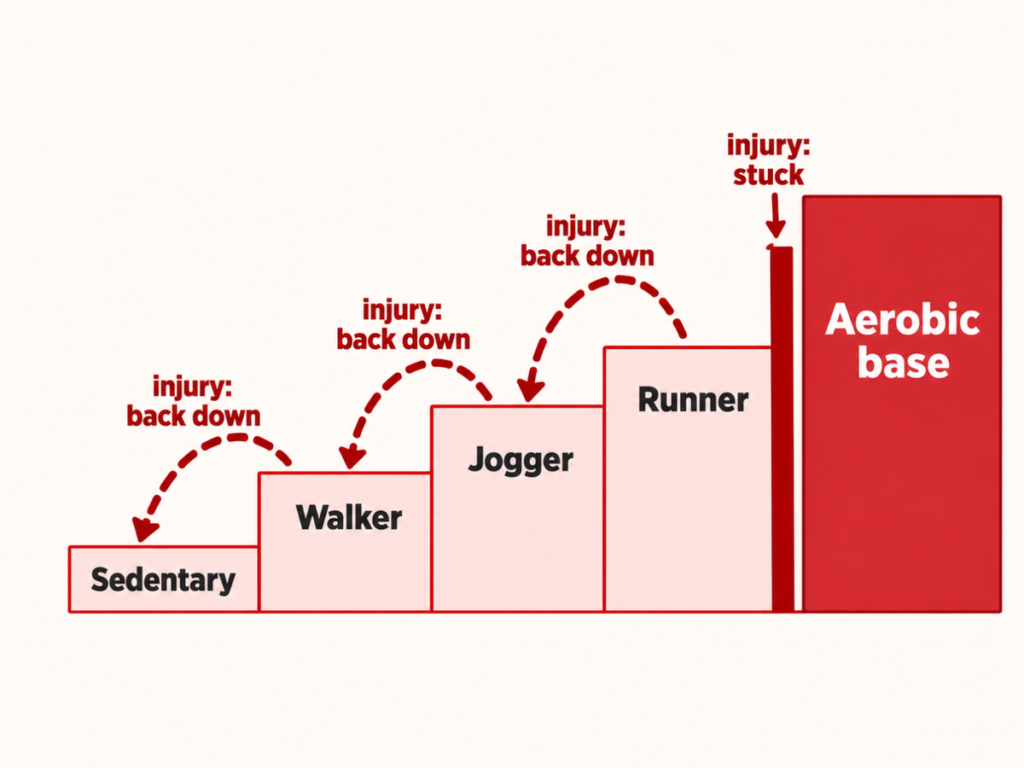
Telangana Runners is a non-profit. Our goal is not a running competition. It is endurance for every person in Telangana. A sedentary person becomes a walker, a walker becomes a jogger, and a jogger becomes a runner.
Set your endurance goal for the next 3 to 6 months. Reach it, then keep it. No rapid progression. Do not run for photos, and do not run for social media appreciation. Plan it healthy, and maintain it.
What is the aerobic base?
Our definition is simple: 30 minutes or more of steady effort, with the heart beating at a steady rate. Walking fast, jogging or running, it does not matter which. What matters is that the effort stays steady and the heart rate does too.
When you hold a steady effort, your heart pumps more blood with each beat. Your muscles take in more oxygen. Your body burns fat and sugar better. This is the aerobic base, and 30 minutes or more is what we ask you to build and keep.
Why does this matter for a whole state?
When a person builds that base, most of the burden of lifestyle disease goes down: diabetes, high blood pressure, heart disease. That means fewer tablets, fewer hospital visits and lower bills. In one global study, sitting still cost the world’s health systems about 54 billion dollars in a single year.
Running is the cheapest sport there is, for any age. A pair of shoes and 30 minutes is all it takes. That is how a whole state gets fitter, one person at a time.
Why are speed and rapid progression the problem?
Speed thrills, but it hurts. Every runner, from a beginner to an athlete, has a story of a sports injury. Almost every one of those stories starts with speed or a rapid jump in training.
A review of 13 studies counted injuries per hour of running. New runners got hurt 2.3 times more often than regular runners: 17.8 injuries per 1,000 hours against 7.7. That is per hour on the road, not per runner, so the beginner’s extra risk is real.
A study of 874 new runners looked at big jumps. Those who raised their weekly distance by more than 30% in two weeks seemed to get more knee, shin and IT band pain. Slow and steady is the safe way up.
What one injury does
An injury delays your progress by weeks or months. An injury can push a person back to a sedentary life, and the whole climb starts again. An injury raises your medical bills: scans, doctor visits, physio sessions, sometimes surgery. And an injury can become a mental injury, especially when it hits a ligament or the meniscus in the knee. The fear of the next one keeps many people on the sofa for good.
So why no cash prize, no pacers, no podium?
Because each of the three rewards speed. Speed is what we do not want for you. Here is how each one works against the goal.
No cash prize
We never sell our tickets on a cash prize. A prize for a fast time rewards speed, and speed is what injures people. So every finisher gets the same gift, the first one home and the last one too.
No pacers
A pacer pulls you to someone else’s pace, not your own steady heart rate. Your heart does not know the pacer’s plan. So you run your own steady effort for 30 minutes or more.
No podium promised
A podium makes you race the runner next to you. We are a health movement, not a running competition. We do appreciate our fastest finishers, and sometimes we thank them with a small appreciation gift. It is never promised before the run, and one day we may stop that too.
Most running events end with cash prizes and a podium, and so they reward the fastest. We are not that event. Our job is to get people out of a sedentary life and keep them coming back, month after month.
So who do you compete with?
You. A runner should compete to keep the fitness they have, or to win back the fitness they lost. Not against the runner next to you, and not for a pace to post on social media.
Give your best endurance effort, finish, and come back next time a little stronger. That is the only win we count. It is the same win for the person who finishes first and the person who finishes last.
Your questions, answered
Is there a cash prize at Telangana Runners events?
No. We never sell our tickets on a cash prize, and we do not promise prizes, pacers or a podium. Every finisher gets the same gift, whether they finish first or last. The reason is in this blog. We build endurance in every person in Telangana. A cash prize rewards speed, and speed is what injures runners.
Are there age categories and winners?
We do not promise age categories, rankings or winners. Sometimes we thank our fastest finishers with a small appreciation gift, never promised before the run, and that may stop one day. The only person you compete with is you. Keep the fitness you have, or win back the fitness you lost, and come back next time a little stronger.
Do you have pacers?
No. A pacer pulls you to someone else’s pace, and your heart does not know the pacer’s plan. We want you at your own steady effort, with your heart at a steady rate, for 30 minutes or more. That steady effort is what builds the aerobic base, and it is different for every runner.
How fast should I run?
Slow enough to talk while you move. Hold that steady effort for 30 minutes or more, and let your heart rate settle at one level. Set a goal for 3 to 6 months, reach it, and keep it. Add a little each week, never a big jump. In a study of 874 new runners, big jumps in weekly distance went with more knee and shin pain.
Build Your Endurance Now
Come out of the sedentary life and join the next run. Build your endurance one step at a time. Find the next run at www.TelanganaRunners.com. Have a heart condition, or been away from exercise for years? Start with a physician supervised exercise intervention: read how cardiac rehab works on CardiacRehab.com, then come and walk with us.
References
- Ding D, et al. The economic burden of physical inactivity: a global analysis of major non-communicable diseases. Lancet. 2016. pubmed.ncbi.nlm.nih.gov/27475266
- Videbaek S, et al. Incidence of running-related injuries per 1000 h of running in different types of runners: a systematic review and meta-analysis. Sports Med. 2015. pubmed.ncbi.nlm.nih.gov/25951917
- Nielsen RO, et al. Excessive progression in weekly running distance and risk of running-related injuries: an association which varies according to type of injury. J Orthop Sports Phys Ther. 2014. pubmed.ncbi.nlm.nih.gov/25155475